Play Now
Join a Game
Characters
Shop
Tools
Compendium
Community

Sign In

Play Now
Join a Game
Characters
Shop
Tools
Compendium
Community
Sign In
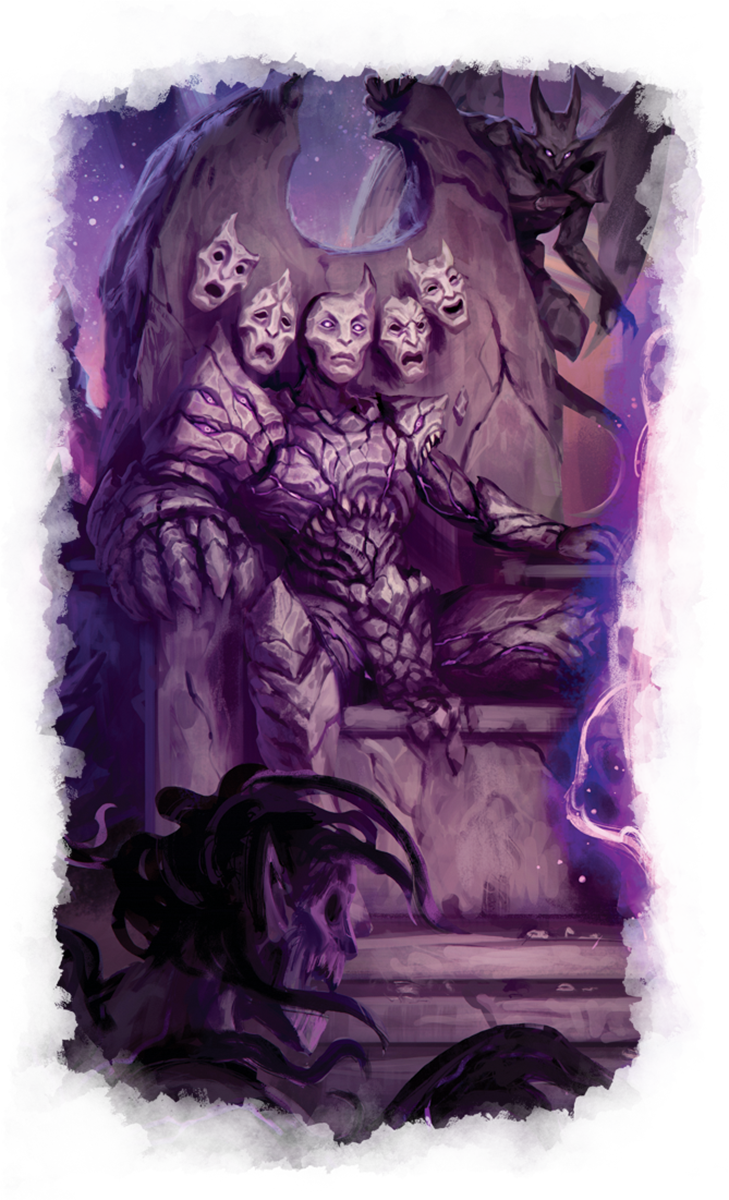 Daelkyr
A daelkyr knows secrets mortals can’t comprehend and has plans they can’t understand. Some sages believe that the daelkyr are artists and that worlds are their canvas; they destroy civilizations and unleash monsters because, to them, this is a thing of beauty. Others say that the daelkyr exist beyond time, and that their actions only make sense when viewed over the course of millennia. Still others assert that any creature that can understand the motives of the daelkyr will immediately turn to their cause—that it is dangerous to study the daelkyr too closely, lest their revelations destroy all prior understanding and identity. While they may be enigmatic, the daelkyr are unquestionably evil; they shatter innocent lives and entire civilizations without any remorse.
Unifying Theme. Each daelkyr has a unique theme. Belashyrra is tied to sight, Orlassk to stone, and Dyrrn to corruption and evolution. This theme is reflected in the daelkyr’s appearance, in the minions it employs, and in the symbionts it creates. If the daelkyr is an artist, the theme is its medium. If it’s a conqueror, the theme defines its weapons and the world it seeks to create. Additionally, each daelkyr holds secrets and revelations relating to its specific theme—secrets mortal minds can’t comprehend. While in Belashyrra’s presence, people may remember things they’ve seen and forgotten. Around Orlassk, they may feel numb… as if their flesh is becoming stone.
Alien and Unsettling. In an encounter with a daelkyr, consider ways to express its alien nature, such as the following:
Any encounter with a daelkyr should be horrifying, driven by its alien, unknowable nature. The actions of the Lords of Dust and the Dreaming Dark make sense; the quori seek to control humanity’s dreams, while the Lords of Dust strive to release their bound overlords. The actions of the daelkyr are just as deadly and destructive, but we cannot understand what they want, and those who attempt to do so often become their cultists.
What if all the world was still, silent, and peaceful? What if everything was stone, perfect, and eternal? This is the promise of the Still Lord. Stone feels no pain. Stone doesn’t fear the passage of time. Embrace Orlassk and you can be immortal and serene. With this in mind, Orlassk and its cults typically follow one of two themes. The first is the idea of flesh becoming stone, of bringing peace and silent perfection to the world. The second is that the stone is alive—that there are voices in the stone, whispering secrets and offering wonders. Cultists of Orlassk often begin as miners guided to rich veins of ore, sculptors who hear the stone telling them how to unlock beauty, or prisoners saved from solitude by the comforting voices in the rock walls. As for Orlassk itself, its motives can only be guessed at. Does it prefer breathing life into stone, as it did with the gargoyles? Does it wish to petrify all organic creatures? Or does it hold the key to a deeper mystery yet to be understood?
Quick Stone. Orlassk’s creations straddle the line between organic and inorganic. One example of this is quickstone, a substance that can shift between malleable and rigid states. Treasures tied to Orlassk may use supernaturally hard stone in place of metal, or involve mineral intelligence. Orlassk creates Ioun Stones that sing to the characters attuned to them, and Barrier Tattoos that give skin the strength of stone. Orlassk is also a source of Figurines of Wondrous Power; while the figurines Orlassk creates can use the stat blocks assigned to the traditional figurines, they are usually carved in the shapes of creatures never seen in Eberron.
Orlassk’s Minions. Orlassk turns flesh into stone and brings stone to life. Places where its influence is strong may be infested with cockatrices or gorgons. His cults often work with gargoyles, stone or clay golems, and earth elementals—though these creatures are all created by Orlassk’s whims, and have no kinship with traditional golems or elementals. But Orlaask isn’t limited to elementals; almost any creature can be carved from stone and given life. In the last days of Dhakaan, Orlassk petrified the dar population of Cazhaak Draal and then animated them, unleashing this stone army against their kin. Legends speak of purple worms made from stone burrowing through the foundations of Dhakaani citadels. A cult of Orlassk could be led by a sphinx made of stone. All of these creatures would be represented with the Stoneborn Template provided in this chapter. As for Orlassk’s cultists, their flesh often shifts to stone, though this is usually hidden beneath their skin. Those that follow this path eventually become stoneborn, but along the way they become Stone Speakers or Stone Listeners. Others never fully transform. After a cult was exposed in Ardev and eliminated, its members were found to be purely flesh and blood—except for their brains, which had turned into marble.
Orlassk is bound within the Heart of Stone, a gravel desert filled with broken statues and towering, unfinished citadels and monuments. Orlassk’s face is carved into a massive mountain, and gargoyles and nameless winged creatures dwell in its eyes and mouth; Orlassk itself dwells in the heart of that mountain, carving new creations from its roots. But Khyber and Xoriat interact in strange ways. The Heart of Stone is a demiplane in Khyber, with portals touching the surface that are sealed by the magic of the Gatekeepers. But there is another passage to the Heart of Stone—a massive, stone colossus stalking through the deepest depths of Khyber. Orlassk itself cannot leave this living citadel, but its creations can crawl out of the mouth of the colossus. Should adventurers be so foolish as to face this horror in battle, it has the statistics of a Stoneborn Tarrasque. The citadel has never ascended from the depths. While nothing regarding the daelkyr is ever certain, Orlassk’s citadel is likely bound below by the same Gatekeeper seals that bind Orlassk.
Lair Actions. While within the Heart of Stone, Orlassk can take Lair Actions. On Initiative count 20 (losing Initiative ties), Orlassk can take a Lair Action to cause one of the following effects. It can’t use the same effect two rounds in a row:
Regional Effects. While passage to the Heart of Stone is blocked by the Gatekeeper seals, there are places in the world where Orlassk’s influence is strong. During the Age of Dhakaan, cultists of the Still Lord built altars of stone infused with the power of the daelkyr. These altars cannot be physically destroyed; the only way to remove an Altar of Orlassk is to find a way to sever its connection to the Still Lord by reconsecrating it to some other power. One such altar lies somewhere near Cazhaak Draal, and its influence maintains the unnatural state of the Stonelands. There is another in the Graywall Mountains near the town of Quickstone; the influence of this altar is directly at odds with the influence of the archfey King Grayfinger. Others could be hidden across Khorvaire, and it’s always possible a cult could create a new altar in an existing city. Regions containing an altar of Orlassk could have one or more of these effects.
If a creature goes mad in Orlassk’s lair or while it can see the daelkyr, it is afflicted with a powerful delusion. Roll on the Delusions of Orlassk table to determine the nature of this delusion, which takes the form of a character flaw that lasts until cured. Chapter 8 of the Dungeon Master’s Guide has more information
on delusions.
| d6 | Flaw (lasts until cured) |
|---|---|
| 1 | “I hear wise voices in the stone.” |
| 2 | “Silence and stillness is perfection.” |
| 3 | “I am turning to stone beneath my skin.” |
| 4 | “I must dig deeper in the earth.” |
| 5 | “Statues are alive and can move if they wish to.” |
| 6 | “I am a statue that was transformed into flesh.” |
Alien Mind. If a creature tries to read Orlassk’s thoughts or deals Psychic damage to it, that creature must succeed on a DC 22 Intelligence saving throw or have the Stunned condition for 1 minute. The Stunned creature can repeat the saving throw at the end of each of its turns, ending the effect on itself on a success.
Curse of Stone. A creature that starts its turn within 60 feet of Orlassk must make a DC 22 Constitution saving throw. On a failed save the creature has the Restrained condition. A creature can repeat the saving throw at the start of each of its turns, ending the effect on a success. If a Restrained creature fails a saving throw against this trait, it instead has the Petrified condition. The Petrified condition lasts until the creature is freed by the Greater Restoration spell or other similar magic. Creatures that have Immunity to the Petrified condition are not Restrained by this trait.
Legendary Resistance (3/Day). If Orlassk fails a saving throw, it can choose to succeed instead.
Magic Resistance. Orlassk has Advantage on saving throws against spells and other magical effects.
Regeneration. Orlassk regains 20 Hit Points at the start of its turn. If Orlassk takes Radiant damage, this trait doesn’t function at the start of Orlassk’s next turn. Orlassk dies only if it starts its turn with 0 Hit Points and doesn’t regenerate.
Multiattack. Orlassk makes two attacks with its Claw, and two attacks with its Stone Fist Symbiont.
Claw. Melee Attack Roll: +14, reach 5 ft. Hit: 17 (3d6 + 7) Slashing damage.
Stone Fist Symbiont. Melee Attack Roll: +14, reach 5 ft. Hit: 18 (2d10 + 7) Bludgeoning damage, and the target is pushed 10 feet and has the Prone condition.
Quickstone Shaping. Orlassk shapes a new minion from among those that have fallen victim to its curse. One Petrified creature of Orlassk’s choice that it can see within 60 feet no longer has the Petrified condition, but is polymorphed into a stoneborn form. While transformed, the target has the Charmed condition, and follows Orlassk’s commands to the best of its ability. The new form can be any stoneborn Beast, Humanoid, Giant, or Monstrosity whose Challenge Rating is equal to or less than the target's (or the target's level, if it doesn't have a Challenge Rating). The target's game statistics, including mental ability scores, are replaced by the statistics of the chosen form.
The transformation lasts for 1 minute or until the target dies. In its new form, the target gains 40 Temporary Hit Points. The effect ends early on the target if it has no Temporary Hit Points left. If the effect ends as a result of dropping to 0 Temporary Hit Points, any excess damage carries over to its normal form.
The creature is limited in the actions it can perform by the nature of its new form, and it can't speak or cast spells.
The target's gear melds into the new form. The creature can't activate, use, wield, or otherwise benefit from any of its equipment.
Teleport. Orlassk teleports up to 30 feet to an unoccupied space it can see.
Stonehide Wings. Orlassk gains Total Cover against one attack that would hit it. To do so, it must be able to see the attacker.
Orlassk can take 3 Legendary Actions, choosing from the options below. Only one Legendary Action can be used at a time and only at the end of another creature's turn. Orlassk regains spent Legendary Actions at the start of its turn.
Quickstone Reach. Orlassk makes a Stone Fist Symbiont attack. The reach for this attack is 120 feet.
Belief in Stone. Orlassk targets a creature it can see within 60 feet. The target must make a DC 22 Intelligence saving throw. On a failed save, it takes 14 (4d6) Psychic damage and believes one of its arms has been turned to stone until the end of its next turn. While affected, the creature cannot make use of an item it is holding with that arm (though it can switch a held item to a different hand).
Whispers of the Statues (2 Legendary Actions). Orlassk chooses a point it can see within 60 feet. Creatures within 20 feet of that point must make a DC 22 Wisdom saving throw. On a failed save, a creature takes 17 (5d6) Psychic damage and has the Frightened condition until the end of its next turn. A creature Frightened by this ability can communicate telepathically with any Petrified creature or any creature affected by Quickstone Shaping that is within 120 ft.