Play Now
Join a Game
Characters
Shop
Tools
Compendium
Community

Sign In

Play Now
Join a Game
Characters
Shop
Tools
Compendium
Community
Sign In
In the first days of the world, the fiendish children of Khyber rose from the darkness to reign over Eberron. The greatest among them were the overlords, who held dominion over the world until the children of Eberron and Siberys rose up against them. Armies of dragons fought against the fiends of Khyber. When it became clear that the overlords couldn’t be destroyed, the couatl sacrificed their lives to build a prison of celestial light: a silver flame that bound the overlords in Khyber. These bonds have held for countless generations, but the overlords still yearn to break free and reclaim the world above.
As long as the overlords are bound by the Silver Flame, they can’t physically manifest in the world. But each overlord embodies a particular aspect of evil, which grows in strength as their servants scheme to unleash their ancient masters. The overlords gain strength when mortals embrace the dark paths laid down for them. And as they grow stronger, they gain more influence.
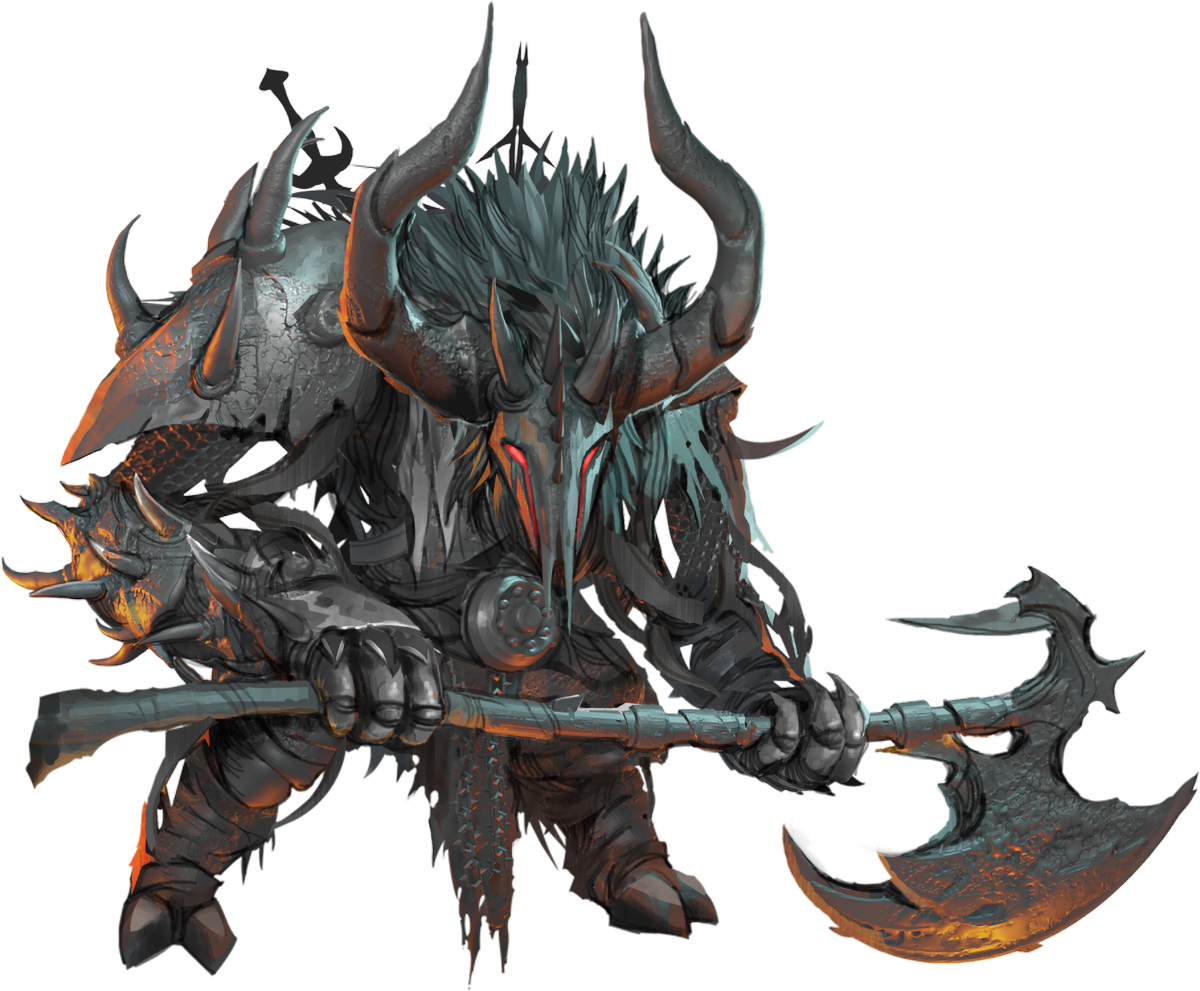
Approximately thirty overlords are bound in Khyber. One is described here: Tol Kharash, the Horned King. Tol Kharash remains imprisoned and can’t take physical form. The stat block provided here reflects the abilities of an avatar Tol Kharash could manifest if he was partially released from his bonds.
Immortal Nature. An overlord doesn’t require air, food, drink or sleep. It also can’t die permanently. Within 24 hours of its death, an overlord will reform in its heart demiplane in Khyber.
When a team of Korranberg scholars studied the region that is now Droaam, they concluded that the Horned King revered in the region was an interpretation of the Rak Tulkhesh, the Rage of War. They were mistaken. Both are spirits of war. But for Rak Tulkhesh, bloodshed and aggression are a goal in and of themselves. For Tol Kharash—the Horned King—war is just the means to an end. The Horned King is an overlord of tyranny and oppression, taking joy in the suffering of the conquered and the cruelty of the conquerors; he delights in mortals inflicting suffering on their own kin.
Tol Kharash can take any form, but his preferred avatar is that of a massive armored minotaur, flesh hidden beneath steel plates. Rusting, broken weapons are embedded in his armor, tokens of defeated foes. The Horned King crushes hopes, and those who see him must fight the urge to grovel or flee.
Destroyer of Hope. Tol Kharash drives the strong to oppress the weak. His essence is bound to the warped tower now known as Turakbar’s Fist, and it seeps out into the surrounding lands. The minotaur clans of the region have been shaped by his power for countless generations, and the chib culture that flourished in the Barrens is a reflection of his influence. The efforts of the Daughters of Sora Kell have curbed his power in the region, but he cannot be driven from Turakbar’s Fist. Around the Fist, the strong feel the urge to revel in their power, to prove their might and take what they desire—while people who are peaceful by nature find themselves more easily cowed, afraid to challenge aggression. Player characters can resist these passive effects. But when an adventurer is in a place where Kharash’s influence is strong, the DM might occasionally ask them questions… Why do you let that wizard tell you what to do? Why do you let them laugh at you? Why don’t you take what you deserve? Most likely, an adventurer will recognize these as the alien thoughts that they are… but the thoughts still linger, and provide a sense of the quiet corrupting power of Tol Kharash. People already driven to aggression—such as the minotaurs of the region, the Gaa’aram orcs and fiend-touched gnolls—can find these impulses especially hard to resist. However, unlike Rak Tulkhesh, the Horned King doesn’t crave chaotic bloodshed. As people fall deeper under his sway they will be drawn to follow the strongest servant of Kharash. Thus, in the present day, both Rhesh Turakbar and Breggan Blackcrown have amassed a force of loyal, ruthless followers—all unwittingly being driven by the power of the Horned King, urged to serve the would-be conquerors.
The Demonglass Horde. Tol Kharash has relatively few fiendish minions. He has no immortal prakhutu, and no representatives among the Lords of Dust. What the Horned King does have is demonglass. Kharash himself is imprisoned in the demonglass tower of Turakbar’s Fist. But many members of his fiendish host were trapped in smaller shards of demonglass. Some have been turned into tools or weapons, fiendish power fueling powerful enchantments. Most cultists of Tol Kharash have a small shard of demonglass embedded in their body, turning them into Demonglass Warriors. Demonglass Champions carry larger shards that grant greater powers, but over time the fiend in the shard eats away at the mortal within, turning them into a hollow one serving as a puppet for the fiend.
The King’s Prison. Tol Kharash is bound by the Silver Flame, and he has no army of rakshasa studying the Draconic Prophecy and uncovering a path for his release. However, the nature of his prison gives him considerable power over the region around Turakbar’s Fist even while he remains imprisoned—and there may be ways for him to increase that influence. The first obvious path is for servants that bear his demonglass shards to conquer in his name; the wider his dominion, the more power he gains. Beyond this, there are two paths that could allow Tol Kharash to walk the world. The first is to create a proper vessel—a mortal who can serve as his hollow one. He has planted his seeds in two mortals in the modern age: Rhesh Turakbar and Breggan Blackcrown. Tol Kharash needs these vessels to grow in power—both personal power and authority, becoming conquerors and embodying his ideals. It’s up to the DM to decide exactly what steps would be involved in this, but it would definitely involve amassing a powerful army and conquering a region. Rhesh Turakbar would need to challenge the Daughters of Sora Kell, while Breggan would have to stake her claim as the descendant of Breggor Firstking and forge a new kingdom of the lost on the frontier. Beyond this, the vessel would have to embed more demonglass in their body, and undergo other rituals that would strengthen their flesh… but they could do this without knowing the deadly road they’re on. Breggan could truly believe she’s gaining the power she needs to challenge Droaam and Breland, not knowing she’s becoming the anchor for an overlord. Ultimately, if one of these vessels follows the path, Tol Kharash would be able to manifest through them—creating an avatar with the statistics presented here. The mortal would still remain, and if that mortal died, the avatar would be destroyed. A second way Tol Kharash could be freed would be if the region itself was pulled deeper into his prison. By planting demonglass anchors in critical locations and performing the proper rituals, a piece of Droaam could be drawn into Khyber… allowing fiends to manifest freely, and Tol Kharash himself to rise from Turakbar’s Fist. Once this had been completed, there would be no simple way to reverse it; it would take something as dramatic as Tira Miron’s sacrifice to channel the Silver Flame to undo this damage. With either of these plots, Rhesh Turakbar would be a willing pawn who seeks to unleash the Horned King upon the world—while Breggan Blackcrown doesn’t realize that she’s a pawn in an overlord’s schemes, and believes her ambitions are hers alone.
Legendary Resistance (3/Day). If Tol Kharash fails a saving throw, he can choose to succeed instead.
Magic Resistance. Tol Kharash has Advantage on saving throws against spells and other magical effects.
None Above Me. Charisma Saving Throw: DC 25, each creature that starts their turn within 100 feet of Tol Kharash and who is positioned above his eye level. Failure: A target must use as much of its movement as possible to move to a space below Tol Kharash’s eye level.
Revel in Tyranny. Tol Khalesh’s attacks deal an extra 10 (3d6) damage against creatures that have either the Prone or Frightened conditions.
Multiattack. Tol Kharash makes four attacks, using Battleaxe’s Blade, Battleaxe’s Blast, or Gore in any combination. He can replace one of these attacks with a use of Spellcasting (at will spells only).
Battleaxe’s Blade. Melee Attack Roll: +16, reach 10 ft. Hit: 27 (3d12 + 8) Slashing damage, and the target is pushed 15 feet away from Tol Kharash.
Battleaxe’s Blast. Ranged Attack Roll: +17, range 120 ft.
Hit: 18 (2d12 + 9) Necrotic damage, and the target has Disadvantage on its next saving throw before the end of its next turn.
Gore. Melee Attack Roll: +16, reach 10 ft. Hit: 34 (4d12 + 8) Piercing damage, and the target has the Prone condition.
Overlord’s Presence. Wisdom Saving Throw: DC 25, each creature of Tol Kharash’s choice that is within 120 feet of him and aware of him. Failure: 33 (6d10) Psychic damage and the target has the Frightened condition for 1 minute. A creature can repeat the saving throw at the end of each of its turns, ending the effect on itself on a success. If a creature's saving throw is successful or the effect ends for it, the creature is immune to Tol Kharash's Overlord’s Presence for the next 24 hours.
Shape-Shift. Tol Kharash shape-shifts into a Beast, Humanoid, or Giant that has a Challenge Rating no higher than his own, or back into his true form. He reverts to his true form if he dies. Tol Kharash retains his Alignment, Hit Points, Hit Dice, ability to speak, Proficiencies, Legendary Resistance, his Intelligence, Wisdom, and Charisma scores, and this Action. His statistics and capabilities are otherwise replaced by those of the new form, except for any features or Legendary Actions of that form. Any equipment he is wearing or carrying is absorbed or borne by the new form (his choice).
Spellcasting. Tol Kharash casts one of the following spells, requiring no material components, using Charisma as the spellcasting ability (spell save DC 25):
At Will: Command, Detect Thoughts, Dispel Magic, Eyebite
3/Day Each: Enemies Abound, Mass Suggestion, Power Word Pain
1/Day Each: Dominate Monster, Imprisonment
Demonglass Prison. Trigger: When a creature Tol Kharash can see within 60 feet is reduced to 0 Hit Points. Response: Tol Kharash can trap its soul within a Small conjured demonglass shard, which appears adjacent to the target. The demonglass shard has AC 15 and 20 Hit Points. While its soul is trapped, a target continues to make death saving throws but it cannot regain Hit Points by any means, until the demonglass shard is destroyed. If a creature dies while its soul is trapped, it cannot be resurrected until the demonglass shard is destroyed. When a demonglass shard is destroyed, Tol Kharash regains 26 (4d12) Hit Points and the newly released creature has the Frightened condition for 1 hour. The Frightened condition persists even if the creature is Unconscious or dead.
Tol Kharash can take 3 Legendary Actions, choosing from the options below. Only one Legendary Action can be used at a time and only at the end of another creature's turn. Tol Kharash regains spent Legendary Actions at the start of its turn.
Attack. Tol Kharash makes one Battleaxe’s Blade, Battleaxe’s Blast, or Gore attack.
Oppress. Tol Kharash casts Command.
Incite (2 Legendary Actions). Charisma Saving Throw: DC 25, two creatures of Tol Kharash’s choice within 60 feet of him. Failure: Targets must use their Reaction (if available) to make a melee attack with a weapon against each other. If the other target is not within reach, a target instead makes a ranged attack with a weapon against the other target, throwing its weapon if necessary. These attacks are made with Advantage and gain a +4 bonus to the damage roll.