
Play Now
Join a Game
Characters
Shop
Tools
Compendium
Community

Sign In

Play Now
Join a Game
Characters
Shop
Tools
Compendium
Community
Sign In
Towns aren’t everything. The Western Frontier covers a vast stretch of land, and many adventures will take place in the space between towns. East of Orcbone, the environment is largely a savanna—vast stretches of grass with occasional scattered trees. To the west of Orcbone lies the region known as the Barrens. While there features break up the landscape—small forests or groves, stretches of especially tall grass, mesas and outcroppings of rock, streams, the occasional chasm—it’s largely open plains and low hills. Here are a few of the particularly noteworthy areas.
 Imagine a line drawn between the northern tip of the Graywall Mountains and the western edge of Silver Lake. Since the founding of Galifar, the people of Breland have referred to everything west of this line as “the Barrens’’—and even today, it is this line that is generally seen as the border between Droaam and Breland, even though Breland doesn’t officially recognize Droaam’s claim. But it’s not an entirely arbitrary line. The environment does suddenly shift as you head west of the Graywall Mountains, becoming drier and harsher. On a map, it looks like an entirely uniform region, a vast unending plain. In truth, it is more diverse. While much of the Barrens is made up of plains covered with scrub grass, there are stone features across the region; not mountains (except for the Great Crag, of course), but mesas and low ridges. There are also a number of deep chasms—cracks possibly caused by ancient tectonic activity, creating canyons that divide the plains. Sometimes these cracks in the earth are less than a foot across, and simply require a little caution. On the other hand, the Korlaac Rift is a massive chasm that runs for nearly 60 miles. The Rift has an average depth of around 2,600 feet, but there are points where it’s far deeper; some say it drops down into Khyber itself. The Rift lies between Graywall and the Great Crag; the western trade road runs to Korlaac Pass, a bridge that spans the four hundred foot gap of the chasm. In addition to these cracks, there are a number of craters that drop down into darkness; these are called gantii’shu, “hungry holes,” as the edges can collapse without warning.
Harsh as it is, it’s possible to cross the Barrens safely and even to live in them; sand fruit isn’t very appealing, but it’s edible. At the same time, this is why there weren’t many large cities in the region until the rise of Droaam. Prior to the Daughters of Sora Kell and their seemingly endless supply of grist, it would have been difficult to support a population the size of Graywall. Most settlements across the barrens are small hamlets housing two or three extended families, spread far enough apart so as not to be competing with neighbors for the limited resources. However, there are stretches of the Barrens that are truly barren—regions of gray sand or bare stone, where all vegetation withers and dies. There’s no environmental logic to the placement of these regions, which the locals call kurarat, “dead lands.” Many scholars believe that these swathes are the result of some ancient conflict, perhaps the war between the Dhakaani and the daelkyr. Most creatures can’t survive in the dead lands; even with their remarkable talents, player characters have Disadvantage on Survival checks made in the kurarat. Fortunately, these stretches of dead land aren’t very wide.
There are Dhakaani ruins scattered around the Barrens. Those on the surface have largely been wiped away by the passage of time; Barrens villages may be built against chunks of old goblin walls, and bandits could hide in the foundations of a long-fallen fortress. But the Dhakaani often built their homes partially or entirely underground. Travelers may find that a new crack in the earth has exposed a subterranean fortress, or stumble upon a sealed vault that hasn’t been opened in over a thousand years—though if it’s remained sealed for so long, it may be hard for adventurers to find a way to open it now!
While most of the inhabitants of the Barrens have always been the creatures that now dominate Droaam—orcs, goblins, ogres, kobolds—until a decade ago there were humans who made their homes here. Some found mineral resources that were worth exploiting. Some were just stubborn. By 988 YK almost all easterners in the Barrens had been killed or enslaved, but travelers may find remnants of human settlements in the region, or be tasked to recover heirlooms lost when the Brelish were driven out.
There are many small hamlets spread across the Barrens. With the rise of cities such as the Great Crag and Graywall, many of these thorps have been abandoned. These ghost towns may have been claimed by bandits or monstrosities… or they could be literal ghost towns, housing tormented spirits.
The Byeshk Mountains form a natural barrier between Droaam and the Towering Wood of the Eldeen Reaches. This range is considerably less hospitable than the Graywall Mountains to the south. The peaks are high and the cliffs are often both sheer and exceptionally hard; the unusual density of the stone makes both the mining and the creation of artificial passes difficult.
The net result of this is that the Byeshk Mountains are an especially favorable habitat for flying creatures, which is likely why they have long been dominated by harpies. Harpy aeries and monasteries are always in places that cannot be reached by landbound creatures, at least not without making a perilous climb.
The civilization of the Droaamite harpies is broken into flights, clans that share unique traditions and bloodlines. While there are many flights that call the Byeshk Mountains home, there are two that make their home near the frontier. The Brass Talon flight holds the southeastern edge of the Byeshk Mountains, the range along the Western Frontier. The Brass Talons are fierce warriors whose combat techniques are similar to the bardic Colleges of Swords and Valor, but the Talons rarely attack without cause; they are a monastic flight who strive to perfect the dance of song, sword, and flight. Travelers will often hear their distant songs, but unless shrines are desecrated, the Talons will usually ignore them. The Wind Howlers are another story. Their territory is to the west, slightly further from the frontier. However, they are an aggressive flight that loves to prey upon the landbound, and harpy reavers often head east to raid. The Wind Howlers are deadly archers and excel at instilling fear in their targets; their bardic traditions are similar to those of the Colleges of Lore and Whispers.
The Byeshk Mountains are noteworthy for their rich deposits of byeshk, an exotic purplish ore with special properties. Glittering purple veins can be seen on cliff faces, thus leading to the name of the range; while beautiful, these surface veins are often “false purple”—thin traces that lack the mystical properties of the deeper veins. While there are a few mines in the range, the unusual density of the stone makes it difficult to carry out mining operations, and thus there are far fewer mines—both active and ancient—than in the Graywall Mountains.
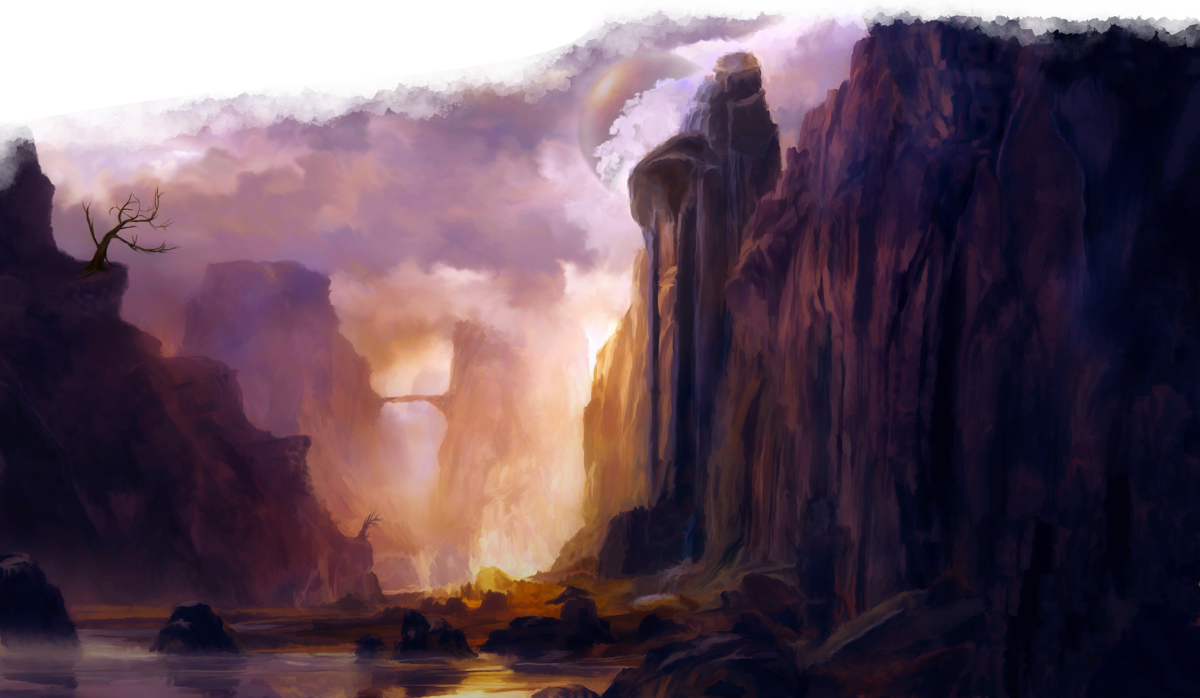
The Graywall Mountains (often just called “The Graywall”) form a significant natural barrier between Droaam and Breland. These mountains were once an important hub for the ancient goblin civilizations, even before the Empire of Dhakaan; if you know your history, you may know that this is where Jhazaal Dhakaan united six warring kings and truly founded the empire. Because of this, the Graywall Mountains are riddled with ancient ruins—Dhakaani cities and fortifications, but also the remnants of even older goblin settlements. However, in the present day, the mountains are almost completely devoid of goblinoids. Historians speculate that the Graywall saw some of the worst conflicts of the Xoriat Incursion—that the majority of the peoples of that time were either completely wiped out or fled into the Barrens. This may be why there are so few hobgoblins and bugbears in Droaam when compared to Darguun, and why the goblins of Droaam have so little attachment to Dhakaani history. Some of the ruins in the Graywall Mountains have been reclaimed by other creatures; in particular, the Khaar’paal kobolds have established a number of subterranean strongholds within the Graywall. Recently, the warlord Kethelrax the Cunning took possession of the ancient city of Shaarat Kol. Other ruins remain undiscovered and undisturbed. But such places may hold deadly traps placed by the Dhakaani in their final days—or more dangerous still, remnants of the forces the daelkyr unleashed in that ancient war.
The Graywall Mountains hold veins of many useful metals, including iron, copper, byeshk, and the various constituent metals used to create adamantine and mithral. There are also a number of significant deposits of mutable quickstone, which was the original reason the town of Quickstone was founded. However, it’s also the case that many of the most accessible deposits were discovered and exploited long ago by the Dhakaani. There are still rich veins to be found, but there’s also a maze of abandoned goblin mines that may be entirely depleted.
Another remarkable thing about the Graywall Mountains is the unusual number of powerful manifest zones. Glaciers in the high mountains often conceal manifest zones tied to Risia. Kobek’s Voice is a dramatically active volcano connected to Fernia. There are a number of zones tied to Lamannia (which some say are the origin of the mutable mineral known as quickstone), and a number of old stories strongly suggest that there are a few intense Thelanian manifest zones hidden in the mountains.
Notable inhabitants of the Graywall Mountains include gargoyles, Khaar’paal kobolds, ogres, and hill giants; the hill giants of Khorvaire appear to be an offshoot of the ogre and to have no ties to the giants of Xen’drik. Throughout the history of the Barrens, ogres have often come down from the mountains to dominate the smaller creatures of the plains; as it turns out, these chibs were just repeating the pattern they knew from the mountains, where hill giants dominate ogre clans. While the Khaar’paal kobolds have a sophisticated culture, the Graywall ogres are more primal; they don’t work metal, and generally employ tools of wood and stone. While there are aggressive clans, not all ogres are hostile to outsiders; a number of the Graywall clans are peaceful hunter-gatherers, who may be excited to host tiny visitors with interesting stories and songs. The Graywall Mountains also include powerful predators, including griffons, giant eagles, and wyverns. There are also unconfirmed rumors of giants in the mountains who are more powerful and sophisticated than the hill giants—but for now, these are only stories.
There are many hidden paths under and through the Graywall that are known to Brelish smugglers, often making use of stretches of abandoned Dhakaani tunnels or mines. If you’re a former smuggler, you surely know some of these crossings. Otherwise, if you need to find a quick path through the mountains, you can surely find a guide at the Crown in Quickstone. . .
Even the sun shuns Nasaar Kol. That’s what people say, and it’s more than just an expression. As one approaches the ancient ruins at the heart of this region, all light begins to fade. In the heart of Nasaar Kol, all effects that would produce Bright Light only produce Dim Light; you may still be able to see the sun, but it is washed out and weak. There is a wide, weak manifest zone tied to Mabar that generates this effect. Within the area, there are points where the Mabaran connection is more intense. The influence of Dolurrh is also strong here, but scattered into dozens of sharp points. There are pools of gray mist where the voices of the dead can be heard whispering; usually, this is an unintelligible babel, but occasionally a clear voice can be heard through the rabble.
At the height of the Empire of Dhakaan, Nasaar Kol was the center of the empire’s necromantic research; “Nasaar Kol” roughly translates to night’s bounty. The dirge singer Iraala and her lover Muurat led this effort. Much as the modern Seekers of the Divinity Within are able to contain the dangerous effects of Mabaran manifest zones, Iraala and her students worked on understanding and harnessing the powers of death and darkness. There is a massive ruined outpost at the heart of this region, but there are also a handful of smaller ruins scattered throughout—places where the Dar experimented with the same sort of skeletal labor seen in Seeker communities, or where mediums plumbed the mysteries of the whispering pools. But the Dhakaani were forced to abandon the region during the Xoriat Incursion. The daelkyr and their forces shattered the fortress and scattered the people, and the restless dead and hungry shadows rose with deadly vigor.
Today, this region is brutally haunted and exceptionally dangerous. Shadows are drawn to the living, and if you enter Nasaar Kol it’s only a matter of time before your shadows will turn on you. There are wights drawn from fallen Dhakaani soldiers, still fighting a war they lost thousands of years ago. And there are countless spirits leaking out of Dolurrh. Some are just wisps of whispering mist. Others are full-fledged ghosts. These restless spirits aren’t as predatory as their Mabaran counterparts, but they are usually confused and driven by the most powerful emotions or moments of their lives; they can be just as dangerous to living creatures that cross their path. All of these things become more intense as you head deeper into the region, and the ancient keep is teeming with wraiths and wights. Thanks to this host of deadly spirits, Droaamites and Brelish alike avoid Nasaar Kol. Occasionally Seekers or other necromancers delve into it, searching for Dhakaani relics or planar-charged resources. Others hope to speak to those they have lost in the pools of mist. But crossing into Nasaar Kol means dancing with death, and the wise avoid it.
There is little flora or fauna in Nasaar Kol. There are shadows of rats and other creatures scurrying in the shadows, harbingers of the more powerful undead. And there is a strain of assassin vine that’s sustained by the energies of Mabar but craves the blood of the living—one more threat to watch out for.
Silver Lake is a massive inland lake. Along with the Byeshk Mountains, it forms the northern border of the Western Frontier. There are small fishing villages spread along the shore of Silver Lake, as well as the Eldeen city of Sylbaran; these are discussed earlier in this chapter. But the lake itself is truly remarkable. In the early days of Galifar, the Arcane Congress confirmed that there is a powerful manifest zone tied to Thelanis at the center of Silver Lake. This results in a strong fey presence throughout the lake. Most of the lake villages have pacts with resident fey, ensuring safe passage for their boats and good fishing hauls; those who anger the local fey can suffer a wide range of misfortunes. But these are minor fey that cling to the shore. There are greater powers at the center of the lake. Remember that Thelanis isn’t just about the fey; it is the realm of stories, founded on faerie tales that leak out into the world. People say there’s a massive serpent in the center of Silver Lake that can shatter ships and swallow sailors—and that one sailor lived for a year in the belly of the beast before finding a way to escape and swim home. There are stories of warships vanishing and of ancient vessels being discovered with no evidence of the passage of time. There are tales of golden fish that can grant wishes and of a grand castle that can only be seen in the reflections on the water. All of these things might actually exist in the heart of Silver Lake, but they are as ephemeral and unreliable as any story. If that serpent exists, it may sleep at the bottom of the lake—or it could spend most of its time in the oceans of Thelanis, only shifting into Eberron under special circumstances.
What is certain is that it’s dangerous to cross Silver Lake unless you’re very familiar with it. You’re safe enough while you’re in sight of shore, though it helps if someone on the boat has a bargain with one of the lake spirits. Crossing the deeper waters is always a risk. Sailors in the region know to avoid fog banks, to throw silver overboard at the first sign of a storm, and a hundred other superstitions that can help mitigate the dangers of the deep water. If you venture into the deepest waters unprepared, anything could happen.
The Whitehorn Wood is a vast forest that lies between Castle Arakhain and Shavalant. “Whitehorn” is the name of a legendary creature—a colossal bear with curved white horns—said to dwell within the wood. There have been no confirmed sightings of this beast for centuries, and there are many who insist that the stories of a bear the size of a castle are at best exaggerations or at worst absolute fabrications. Whatever the truth, it is a concrete fact that there is a powerful Lamannian manifest zone on the northern edge of the wood. This accelerates the growth of animals and plants, and undermines any attempts to cut back the forest or introduce the trappings of civilization within it. Beasts often seem to be guided by some greater force which coordinates their actions to deal with anyone who would despoil the wood—though when people have used Speak with Animals to talk to these beasts, they deny being actively controlled and say that whatever they were doing “just seemed like the right thing to do.”
While there are rumors that a few Ashbound druids took refuge in Whitehorn after attacking Shavalant a few years ago, there’s no widespread population of druids within Whitehorn. People say that the wood just doesn’t like people, whether they’re druids or lumberjacks. The people who live near Whitehorn do harvest and hunt on the edges of the wood, but everyone knows not to take too much from the Wood or to go too deep within it. With that said, there are exceptions to any rule. Perhaps a cell of the Swords of Liberty or a troop of brigands have come to terms with Whitehorn and are using the wood as a safe haven. Perhaps the wood spawns a force of myconids to defend its borders, or the Wardens of the Wood will send a delegation to try to make peace with Whitehorn!