
Play Now
Join a Game
Shop
Tools
Characters
Compendium
Community

Sign In

Play Now
Join a Game
Shop
Tools
Characters
Compendium
Community
Sign In
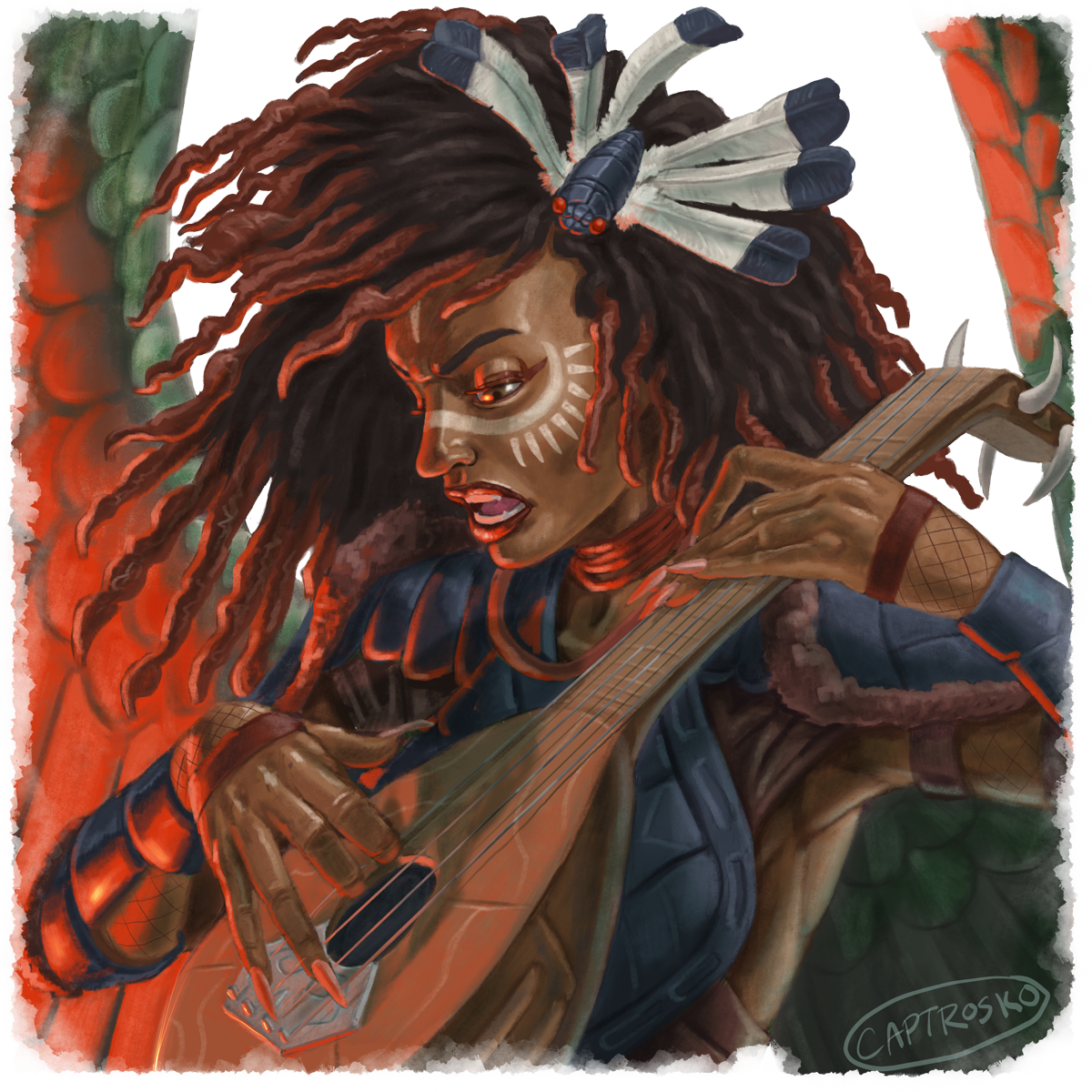 "I can’t help it if you’re drawn to my voice. I sing what I feel. If my song draws you closer, you have a choice; will you fight what you feel, or will you dance with me?"
—Taleth of the Forgotten Choir
To be a harpy is to feel. Harpies are intense and passionate, experiencing all emotions deeply, and they channel these feelings into their songs. A harpy’s voice is an outlet for all the passion they feel, and singing is a joyous release. The same is true of motion; for a harpy, soaring through the air isn’t just a way to get from one point to another, it is a dance with the currents and the wind. Throughout most of the history of Galifar, harpies remained on their mountain peaks. Now they have descended to work with Droaam and Tharashk, and the harpy’s song plays a vital role in holding the new nation together.
Harpies are winged humanoids. The harpies of the Byeshk mountains have birdlike legs, and rough skin and claws on their hands. Other cosmetic details vary by bloodline; some harpy lines appear largely human, while others are more elven in their features. The harpies of the Last Dirge have hobgoblin features; it’s said that the legendary duur’kala Jhazaal Dhakaan learned the secrets of song from an elder of this line. Male harpies are rarer than their sisters, but they do exist.
Until the last decade, the people of the east only knew harpies through tales told by explorers and templars. The sage Dorius Alyre ir’Korran wrote “Taking glee in suffering and death, the sadistic harpy is always on the hunt for prey. Its sweet song has lured countless adventurers to their deaths, drawing them in close for the harpy to kill and then consume.” They were said to be children of the Fury and the Shadow set on Eberron to torment innocents and drive people to madness; the name harpy was a pejorative term. Scholars can point to historical examples of explorers drawn into chasms and other hazards. However, in many of these cases, the luring harpy wasn’t even aware of the adventurers doomed by her voice. She sought only to sing, to express her joy or her sorrow—and those who heard her wanted nothing more than to hear her better, ignoring all dangers as they pursued the haunting song. Most harpies take no glee in suffering or death, but they cannot help the impact their voices have on the people around them. This is why the harpies have long dwelt in the highest mountains—to avoid harming innocents, to live in a space where they can dance with the wind and sing with full throat.
Harpies have dwelt in the Byeshk Mountains for countless generations. They carve roosts into cliff faces with the power of their songs, and have felt no need to build cities or raise monuments; in their isolation, they don’t need walls to defend themselves from enemies. Culturally, the Byeshk harpies are split into flights, and within flights they are further split into communities known as choirs. Flights are defined by traditions and by their songs; much like the Phiarlan elves, certain songs are treasures of a flight, heirlooms passed down to a single chosen singer.
A decade ago, Sora Katra came to the high peaks and spoke to the elder voices of each flight. She painted a picture of a nation united, of the scattered creatures of the Barrens singing one song, and she asked the elders to descend and make this vision real. Harpies are passionate, and the leaders of the flights were passionate in their views. Four flights—the Carrion Callers, the Last Dirge, the Rotwings, and the Stormsingers—embraced Katra’s vision, choosing to leave their mountain homes behind and lead their entire flights behind. Others refused. Some had no desire to leave their high mountains. Others doubted Katra’s ability to achieve her dreams or questioned her motives. Callain of the Bloody Word said that the people of the world weren’t meant to sing with one voice. The harpies of the Haunting Song took this further, swearing to use their voices to break Katra’s vision. This led to the Carrion Callers and Stormsingers joining their voices together to break the Haunting Song. Katra chose to leave the other six dissenting flights in peace. They do not harm Droaam in their high peaks, but they take little part in it. While down below, the harpies of the four flights that are bound to the Daughters have spread across the realm. Harpy song is the mortar that binds the nation together. Songbirds rouse people’s spirits at the start of a work day, and soothe them when work is done. Harpies inspire and delight; they can give hope to those who doubt, and end conflicts with a peaceful word. And when it comes to war, they can use their voices as weapons. Most harpies take no glee in suffering and death—but in the first attack on Orcbone, harpy songs had defenders flinging themselves off the walls of the fortress to reach the source of the song. And the harpies serving with Daask have learned that a lure can be a devastating weapon in a city formed from bridges and towers…
Harpies love what they do. If they don’t love it, they won’t do it. For a harpy, singing isn’t merely a magical tool; it’s an ecstatic act, a work of art and communion with the Fury combined. Whether singing goblins to sleep in a grist mill or carrying messages in Sharn, harpies embrace life with absolute zeal. But they hate just as strongly as they love. And little is more terrifying than a harpy roused to anger.
Byeshk harpies revere the Fury, though they generally refer to her as Ur’kala or just Kala—the First Song, or simply the Song. They don’t care what others believe, and will use the name of the Fury when speaking Common as it’s the name others know. Each flight has its own story of the Song. The Stormsingers say that the Fury and the Devourer are one and the same, that the Song shapes the storm even as she drives the currents of the heart. The Last Dirge believes that the Song began at the first moment of creation, and that when it reaches its end the world will fade away. Regardless of belief, harpies feel the power of the Song flowing through them when they sing. However, it is power that must be mastered. The legendary lure isn’t something all harpies can do; it is an art, and among the harpies those who can perform this are called sirens. But all harpies have power. The most basic gift that all harpies possess is the power to cast Friends—shifting emotions with a word. All harpies have access to a particular set of effects—Charm, Suggestion. But beyond the abilities granted by the Harpy species, many class abilities can be linked to voice. It’s easy to see how a harpy Bard can tie her magic to her song, but a harpy Cleric will sing her prayers; a harpy Druid channels the power of nature with his voice; and a harpy Warlock could depict her Eldritch Blast as sharp words that strike with physical force. Rangers are common among the Byeshk harpies. Archery is a useful art for flying hunters, and Ranger magic can likewise be tied to song; the Hunter’s Mark of a Byeshk Ranger is sung as a curse.
The full name of a Byeshk harpy is a song that can take minutes to sing. They use diminutive names for common use and for dealing with strangers. Harpies are fond of deed names—Callain of the Bloody Word—and if they have no deed to share, will often invoke their flight—Taleth of the Forgotten Choir.
Female Names: Baeleth, Callain, Cazha, Daeraleth, Jalira, Lharrain, Mazalara, Sorasara, Surrain, Taleth, Zoryanna
Male Names: Barakan, Bakar, Canto, Daralan, Jakar, Lurran, Morro, Sorran, Surakar, Taluran, Zakaro
When playing a harpy, consider your driving passion. What do you love most in life? What do you want, and how do you express that desire? Consider that your voice has power; that for you, it takes an effort not to cast Friends when you speak passionately about something, because the effect is just part of your voice. Embrace your path, speak your mind, and live a life without regrets.