
Play Now
Join a Game
Shop
Tools
Characters
Compendium
Community

Sign In

Play Now
Join a Game
Shop
Tools
Characters
Compendium
Community
Sign In
Sora shook her head. “I don’t get it, Cin. Why did you leave the Demesne?”
“It’s only now that I could leave,” Cinderan said. “Our ancestors feared their enemies, and hid our demesne behind potent wards—shields that kept us within even as they protected us from whatever lay without. We have had great gifts from our ancestors; knowledge and power. But trapped within their wards, we had to find ways to pay for magic without the ease of dragonshards.”
“What did you come up with?”
“Our traditions of magic are not… kind. We pay the price with blood. With pain. With tears.” He touched his eye, and looked at the drop on his finger; for an instant it burned with crimson light, then it was gone. “Some days I miss the many wonders. The gardens of sensation. The pool of infinite reflection. But every night I pray my family never calls me home.”
In the tales of the Five Nations, tieflings are touched by malevolent planar powers from beyond Eberron. Throughout much of Khorvaire, tieflings are seen as ill omens and heralds of misfortune, even more so than those who carry aberrant dragonmarks. Such planar tieflings don’t pass their traits to their children, and their rarity is part of what fuels fears. But there is a place where entire families of tieflings rule over a city of wonders. These tieflings are descended from the lords of the fallen nation of Ohr Kaluun. During the Sundering of Sarlona, these lords fled to Khorvaire and established a refuge, shielded from mundane and mystical sight. The tiefling lords and their human subjects remained in this shielded sanctuary for over a thousand years, building a city-state of arcane wonders. But the shields that protected the Venom Lords prevented them from leaving the demesne, and they had to take extreme measures to control their numbers and to power their many wonders. Ohr Kaluun was a harsh land, and the power of the tiefling lords came from old pacts with malefic forces; they were more than willing to walk the road of painful sacrifice to achieve their goals.
It was Sora Teraza who first came to the Venomous Demesne. Her blind eyes were not fooled by illusions, and she walked through the wards as if they didn’t exist. She spoke with the Venom Lords and told them of their futures. None know just what she said, but the next day the artificers of the Maze of Making were ordered to craft a gate that would allow passage to the world beyond the wards. Today, humans and tieflings of the Venomous Demesne can be found across Droaam. Human magewrights are helping to develop the arcane infrastructure of the new nation, while the noble tieflings bring greater powers to bear. Some tieflings see the world beyond the wards as a miserable backwater, hopelessly primitive. But others take real pleasure in helping to build something new, in exploring lands unbounded by wards, in walking beneath the sun and finding new paths to power that don’t carry the burdens of the Demesne.
The tieflings of the Venomous Demesne don’t use the options presented in chapter 4 of this book. Instead, they can use any of the Fiendish Legacies presented in the Player’s Handbook—Abyssal, Chthonic, or Infernal. These are hereditary traits reflecting the experiments and pacts of their ancestors; the noble families of the Demesne are tied to specific legacies.
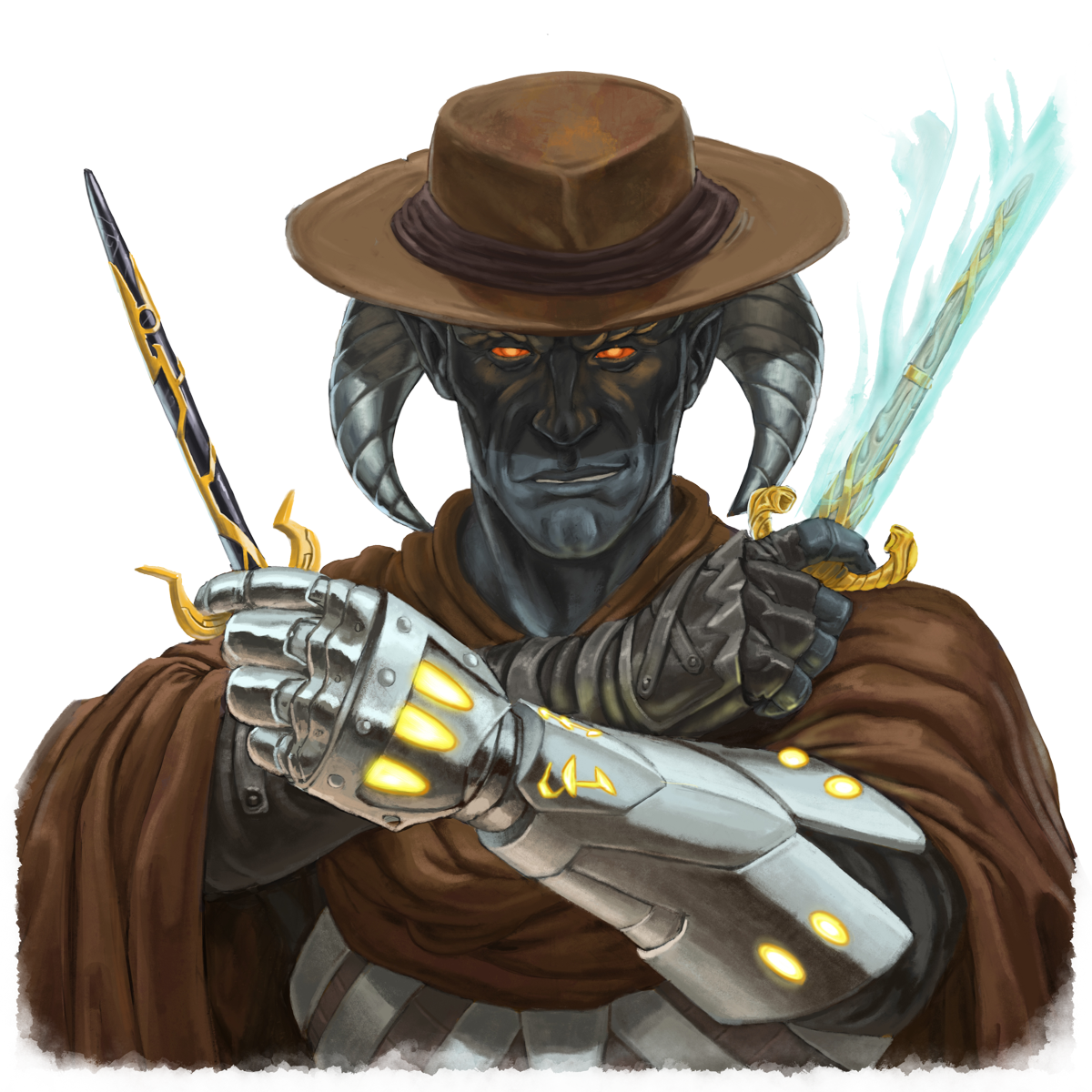 The Venomous Demesne is a place of arcane wonders. While the Demesne is sending its magewrights and scions out into Droaam, it refuses to allow outsiders in through its gate. Because of this, little is known of the Demesne beyond the stories shared by its wandering denizens. What is known is that the Demesne is governed by four power groups, which act both as political factions and as practical institutions.
The Maze of Mysteries is the seat of wizardry—power that can be harnessed through formula and skill. The Maze of Mysteries is focused on research, including innovations that can be shared with the Maze of Making. Tieflings of the Maze of Mysteries are often the proudest denizens of the Demesne, maintaining that they need not rely on tools or outside forces.
The Maze of Promises is the seat of the petitioners—the practice of bargaining with and binding supernatural forces, including fiends, fey, and elementals. The maze maintains relationships with a number of powerful entities and holds a menagerie of minor spirits bound. Its archives contain records of all pacts and entities dealt with in the past. The Maze of Promises also deals with extraplanar travel and communication. It has long been the largest and most powerful of the four mazes, in part because diplomacy and intrigue are vital parts of its function. It is located within a manifest zone tied to Daanvi, and Daanvian fiends are some of the strongest patrons of the Demesne. While petitioners learn to bind and banish fey, pacts with fey are discouraged; an adventurer with ties to an archfey may have defied their family’s traditions.
The Maze of Faith is the seat of the eremites. It is something of a paradox, as its members approach the divine from a dispassionate, scientific perspective—as a source of power to be harnessed—yet also recognize that doing so requires transcendental faith. Some adepts of Faith are capable of believing anything they put their minds to, while others use potions or other techniques to temporarily enter a state of devotion. It is the smallest of the four, but its access to Resurrection ensures its continued influence. The eremites are often seen as eerie even in a nation of tieflings, but they also produce some of the greatest artists in the Demesne.
The Maze of Making is the seat of artifice, built within a Fernian manifest zone. It bears the practical duty of maintaining the infrastructure of the Demesne, and is focused more on this concrete work than on research. While Making plays a crucial role in daily life and now, a key role in producing goods that can be exported from the Demesne, it is the least prestigious of the four mazes.
In the parlance of the demesne, petitioner is the common term for “warlock”, while eremite is used for divine spellcasters; a paladin would be a “warrior eremite.” Artificers are generally called makers. While certain classes are obviously associated with particular mazes, concepts can be reskinned to fit the theme of a particular maze. For example, a Demesne Bard who casts magic due to their knowledge of arcane science would come from the Maze of Mysteries, and might be determined to unlock greater mystical secrets. But a Bard could come from the Maze of Promises, emphasizing their reliance on their charisma, and presenting their spellcasting as the product of bargains made with a host of minor spirits. A Demesne Zealot Barbarian could be a product of the Maze of Faith, driven by ecstatic trances; or they could be from the Maze of Promises, drawing their rage from a lesser fiend bound to their flesh.
The heads of the tiefling families are known as the Venom Lords, but the Demesne is ruled by the Council of Four—the current masters of the Four Mazes. These tieflings set aside their names upon taking their seats; thus, the current council is composed of Lady Faith, Lord Maker, Lady Promise, and Lord Mystery.
The civilization of the Venomous Demesne possesses a level of arcane science beyond that of the Five Nations. Overall, spell effects of up to 5th level can be seen at work in daily life and effects of up to 7th level can be encountered; the Maze of Making can reliably produce Rare, Very Rare, and even Legendary items. Teleportation and extradimensional spaces are incorporated into transit and housing. Casual illusions are used for entertainment and practical purposes. While the Maze of Mysteries is familiar with necromancy, the use of undead is quite rare in the Demesne… not because of any squeamishness, but simply because the traditions of the Demesne have other uses for the resources involved. Because all magic comes with a price. In the wider world, Eberron dragonshards are used to fuel arcane industry. But the Venomous Demesne was cut off from the outside world for over a thousand years; they had to find other sources of energy. The lords of Ohr Kaluun had long dealt with malefic powers and beyond that, the Demesne needed to limit its population. This led to the development of techniques that draw on the living for power. Two common currencies of the Demesne are pain and time—each of which is transmitted through the medium of blood, drawn out in drops or carried in vials. Pain involves the immediate experience of pain, and is measured in loss of Hit Points. Time draws on the life force of the subject, providing a far greater yield than temporary pain, but resulting in a permanent reduction of an individual’s maximum Hit Points. There are many other forms of currency, depending on the needs of the project and what the subject has to offer. Heartfelt tears have power. True and dangerous secrets can be useful. But the greatest power is the soul itself. There is a vast engine beneath the Maze of Promises that catches the souls of all who die within the wards of the Demesne. Souls with value may be set aside and given to the Maze of Faith for the possibility of resurrection. The rest are drawn into the great engine and distilled into crystal shards, which are capable of fueling magic just like an Eberron dragonshard.
This is the world a Demesne tiefling is used to—a life in which you might pay for a meal with a minute of your life or purchase a gift with a sliver of your father’s soul. It is a world of wonders, in which the gods themselves are seen as tools to be used. But it is a harsh life, and there are many scions of the Demesne who take some joy in leaving their home behind.
On a practical level, the cost of magic is something that only affects player characters in a cosmetic fashion. There is no cost to casting a cantrip, unless the adventurer wants to say that they jab their palm with a needle to trigger a jolt of pain. The soul-shards of the Demesne function just like Eberron dragonshards; they can be used in place of other costly components. So a Demesne eremite can use a soul-shard to cast Divination instead of burning incense… but a Demesne Wizard doesn’t need to burn a fragment of a soul to cast Magic Missile. Like dragonshards in the wider world, it is the fuel of industry more than it is used by the typical adventurer. However, this is a key element in the fact that, as powerful and wondrous as the Demesne is, it lacks House Cannith’s capabilities for mass production. The Maze of Making can produce Legendary magic items—but it can’t produce them quickly or in vast quantities.
The nobles of the Demesne are proud of their blood, charged as it is with the Fiendish Legacies of their ancestors. The founders of the Demesne stated poison runs in our veins, power that would kill any too weak to bear it. The noble families are thus known as the Venom lines, and this in turn is why the realm is the Venomous Demesne. There are a dozen major Venom lines, four tied to each of the Fiendish Legacies. When a child is born from the union of two lines that carry different legacies, they take the name of the line whose legacy they manifest. Here are a few of those twelve lines; the others are left to the DM to develop.
Bhar Doluun is an Infernal line with strong ties to the Maze of Promises. They have pacts with powerful fiends of Daanvi and often serve as justiciars within the Demesne. Their Warlock patrons can be classified both as Fiends and Great Old Ones; the latter being fiends that pry into the minds of others, ripping out secrets and crushing resistance. They are proud of their power and role.
Kotharoth is an Abyssal line with equal ties to all the Mazes. They have a strong tradition of alchemy and are especially adept in the creation and use of poisons. Kotharoth mages have developed variant spells that replace the usual damage type with poison damage—Toxic Shield as a variant of Armor of Agathys, Vengeful Venom in place of Hellish Rebuke. Kotharoth heirs are known for their subtlety and for never releasing a grudge.
Orncaex is an Infernal line traditionally tied to the Maze of Mysteries. They focus on war magic and evocation, but the line also possesses a powerful sentient artifact from Ohr Kaluun—the Blade of Twilight Flame, which they say will be driven into the heart of the sun on the last day of the world—and this occasionally empowers Hexblade Warlocks. The Orncaex are exceptional arcane duelists.
Vulkhesh is a Chthonic line closely connected to the Maze of Faith. Its heirs are often seen as gloomy or introspective, but the line has produced some of the most gifted poets and bards in the history of the Demesne. When a Vulkhesh Bard uses Vicious Mockery, they don’t mock the victim; they speak tragic truths that unsettle even the most confident of warriors. Vulkhesh has also been the source of some of the greatest diviners and oracles of the Demesne, though none can match Sora Teraza.
Beyond family, Demesne society is driven by esoteric titles. The Demesne has very limited space to parcel out to its nobles, but it has heirloom objects, ranks reflecting mystical skill, and positions in a few arcane orders—and competing for these titles has been a major source of entertainment for the Venom Lords in their long isolation. So a tiefling noble might be Baelan Bhar Doluun the Seventh Seal, Keeper of the Black Wand and Magister of the Iron Hand.
The tiefling families are the nobility of the Venomous Demesne. Their tiefling nature is seen as proof of their power and their ties to the ancient history of their civilization. But the majority of the population of the Venomous Demesne are human—well, mostly human. Over the course of countless generations and isolation within the Demesne, many of the humans of the Demesne have developed minor mutations, as shown on the Demesne Human Quirks table. These might be tied to a trace of noble blood, or they could be the result of the human’s work for one of the Mazes. A human who has the Unnatural Skin quirk could have vivid red skin due to a trace of an Infernal Legacy, or they could have been a magewright in the Maze of Promises and have the terms of an arcane contract inscribed across their body. The society of the Demesne is loosely feudal, and humans begin their lives as vassals of a noble family. Those that display sufficient skill can earn positions of authority within one of the Mazes. The humans of the Demesne can be artisans and merchants as well as menial laborers, but even a successful family of merchants are vassals to a Tiefling family. In addition, justice in the Demesne is exceptionally harsh when dealing with humans; in a society where blood, pain, bone dust, and souls are the fuel of the magical economy, any crime can carry a death sentence. As such, the chance to leave the Demesne and to engage with the rising nation of Droaam is an exciting prospect for many humans—although many do find the primitive state of Droaam a sharp change from the Demesne.
The Demesne is a mystically advanced civilization. While humans are functionally servants, they are still citizens of the Demesne and the last legacy of its glorious past; as such, they are educated and receive basic mystical training. Most humans from the Demesne have a background that provides the Magic Initiate feat. The Magewright background (see chapter 4) is the most common option, but Acolytes serve in the Maze of Faith and Scribes are found within all the Mazes. Prestidigitation, Thaumaturgy, and Magecraft (from Exploring Eberron) are all common tools in everyday life, even more so than in the Five Nations.
| d8 | Quirk |
|---|---|
| 1 | Unnatural Skin |
| 2 | Unusual Hair |
| 3 | Small Horns |
| 4 | Extra Digits |
| 5 | Inhuman Eyes |
| 6 | Sharp Teeth |
| 7 | Strange Odor |
| 8 | Roll Twice |
The names of the Venom Lords draw on both Draconic and Infernal roots. Four of the noble houses have been mentioned, and the DM and players can name and create new lines. However, a tiefling who has chosen to leave the Demesne might not wish to share their true name for fear of the power it might grant over them, and might adopt a nickname or something with an eastern style.
Female Names: Aesthyr, Aurix, Baelu, Eremyssa, Khalara, Miirik, Nytha, Sulaa, Tokara, Tessalyn, Uxala, Xarala
Male Names: Andar, Baelan, Cindaron, Dol, Edar, Kholan, Orn, Rakhar, Sulaan, Tokar, Xuusan
Here are a few things to consider when playing a human or tiefling from the Venomous Demesne.
Why have you left? Are you on a mission on behalf of your family? Are you on a path that will help you gain power and prestige when you return to your home? Have you left the Demesne to pursue a path your family doesn’t approve of—such as becoming an Archfey Warlock when you were supposed to be bound to a Daanvian fiend? Or are you an exile or a renegade, perhaps fleeing the aftermath of a feud between houses?
What do you miss? Your home is a place of arcane wonders, and, by comparison, both Droaam and Breland are extremely primitive. What is the thing from your home you miss most?
What is your secret? The Venom lines have pacts, promises, and webs of intrigue. Are you involved in an ancient feud? Are you sworn to an abyssal marriage? Are you carrying a subtle curse? Did you do something terrible in your youth to get the power that you possess?