
Play Now
Join a Game
Characters
Shop
Tools
Compendium
Community

Sign In

Play Now
Join a Game
Characters
Shop
Tools
Compendium
Community
Sign In
Approaching Quickstone, the first thing you see is the wall. Over forty feet tall, the color of dried blood, emerging from the cliff face as though it was a part of the mountain. No surprise the first settlers built their homes against it; that wall’s older than Galifar and stronger than the towers of Sharn. But seeing it, you can’t help but wonder… it’s only PART of a fortress wall. What kind of power could have torn down the rest of it?
—Tragomir Narathun, scholar
As shown in the following timeline, Brelish pioneers first settled the town after discovering the quickstone quarry, naming this hamlet Graystone. The settlement survived a handful of raids, but in 987 YK its people were slaughtered by a force of armored trolls and Znir gnolls and the hamlet was abandoned. In 992 YK, a coalition of miners, merchants, and smugglers (many of them devotees of the Three Faces of Coin, a Sovereign mystery cult) rebuilt the settlement as Quickstone. In the wake of the Last War, Count Thavius ir’Blis allowed a force of Cyran refugees to settle in Quickstone, and also granted land in the region to soldiers that served him in the Last War. In addition to investing in the town himself—building the town hall and appointing a sheriff and an administrator to oversee Quickstone in his name—ir’Blis reached out to outside investors. This drew the interest of House Orien and House Ghallanda, as well as Honoria Soldorak—a wealthy Mror merchant who purchased the rights to the abandoned mines adjoining the town. The town has continued to grow over the last two years, as houses are still being built for the many people living in the Tents and veterans work to establish farms. The arrival of House Orien’s lightning rail and the investment of House Kundarak are major developments, and it remains to be seen what the future will hold.
| Date | Event |
|---|---|
| ??? | The Western Wall. An ancient fortress fell into ruin, leaving only the Haunt and sections of its outer wall. |
| 970 YK | Graystone. Brelish pioneers establish the village of Graystone. |
| 987 YK | Graystone Lost. Graystone is sacked by Droaamite forces and abandoned. |
| 992 YK | Oldtown. The town of Quickstone is established by an alliance of miners, merchants, and smugglers. The Crown, Tuuva Mercantile, and other Oldtown businesses are established. |
| 996 YK | The Square. Count Thavius ir’Blis builds the town hall and appoints Magistrate Facet and Sheriff Constable. Cyran refugees and Brelish veterans arrive, establishing the Tents. The Anvil and the Livery are built. Sivis Stone 182 is established, but the Speaking Stone is inoperable. Honoria Soldorak constructs Soldorak Manor. |
| 997 YK | Main Street. Orien Station and the Gold Dragon Inn are established, as the dragonmarked houses take an interest in the region. By the end of the year, the lightning rail connects Quickstone to Ardev and Lord Seneschal Emerick d’Orien arrives, along with the Khaar’paal kobold clan. |
| 998 YK | Today. House Kundarak is building a large enclave and Main Street continues to expand. Orien is negotiating to expand the lightning rail into Droaam. |
 There are a number of crucial elements that shape daily life in Quickstone, and that have contributed to making the town what it is today.
Quickstone is home to approximately 1,600 people. At least a hundred of these are temporary residents, in town while conducting business in the region or just passing through. Over four hundred people live in the shantytown known as the Tents; some of these people are just waiting for their permanent residences to be built, while others are dwelling in squalor while hoping to find a path to fortune. The vast majority of the people are Brelish, with the typically diverse Brelish makeup; slightly less than half of these residents are humans, while the rest are a mix that includes gnomes, halflings, dwarves, elves, half-elves, and goblins. Though other species are rare—there’s only a handful of shifters in town, and currently no resident tieflings—the people of Quickstone are used to just about anything. In 997 YK a clan of kobolds moved into the Tents, and while there are some who shun the kobolds—notably Brelish veterans who fought on the western front during the war—today kobold musicians perform at the Crown inn and the Rose Theater, and Littlehand Haberdashers have adopted certain popular kobold fashions.
The population of Quickstone continues to grow, and the town is struggling to keep pace with the new arrivals. The communities and cultures found in Quickstone are discussed in detail later in this chapter.
Quickstone is an unusual substance that can be encountered in three forms. Soft quickstone is a soft, red material similar in consistency to sandstone, though surprisingly lightweight. Wet quickstone, often called the quick by miners, is a blood-red material with the consistency of soft clay; this form maintains its fluid consistency even when exposed to heat. Fixed quickstone is rust-brown in color, like dried blood, and is considerably harder than granite. In the mountains, quickstone can be found in its wet or soft forms. What makes quickstone remarkable is how it responds to arcane energy. Using arcane rituals, it’s possible to shift quickstone back and forth between its wet and soft forms. Another ritual transforms it into fixed quickstone—though once it is fixed, it can’t be changed again. Many of the buildings in Quickstone have been sculpted from quickstone, but as they are fixed they can’t be remolded. The sculpted houses of Quickstone look as if they were molded from clay, though the fixed quickstone is far more durable than clay, or even wood.
To date, quickstone has only been found in the Graywall Mountains. Its origin is a mystery; it’s too widespread to be the result of a manifest zone. The ancient Dhakaani goblins of the region used quickstone in their structures, and it was the dar who first established the quarries above Quickstone. Some might wonder how it is that the quarries weren’t mined out long ago; it’s almost as if the quickstone grew back over the course of thousands of years.
The quarries and the town have plenty of work for miners and masons with strong arms, people who can excavate the stone and move it where it needs to go. But there’s also a specialized form of magewright that’s a vital part of this process. Stone chanters learn and perform rituals that allow them to shift quickstone between its three forms. They can also use a specialized form of the Mold Earth cantrip (from Xanathar's Guide to Everything) that they use to shape wet quickstone when building large structures. Quickstone isn’t the only town that has stone chanters or quickstone—there are other, older mining towns further south along the Graywall Mountains—but it’s still a specialized tradition that’s only just now becoming common knowledge further east as quickstone is being exported. In theory, anyone could learn to perform the stone chanter rituals with enough time and practice, but certain people in Quickstone seem to have a knack for it; these chanters say they can hear the stone whispering to them. In Quickstone, about one in ten miners is a stone chanter.
While quarrying quickstone is the primary industry in Quickstone, there is a second rare resource in the Graywall Mountains: the purplish metal known as byeshk. The people of the Five Nations have little experience with byeshk, and are still discovering its properties and value. There is a network of old byeshk mines in and below the mountains south of Quickstone, but unlike quickstone, byeshk doesn’t grow back. Beyond that, these upper mines are largely played out, as well as being infested with cockatrices and other dangerous creatures. However, Quickstone resident Honoria Soldorak has bought these mines from Count ir’Blis and wants to have them fully explored. If significant byeshk deposits remain, they could be of great interest to both Soldorak and House Cannith. See the “Byeshk Weapons” sidebar in chapter 5 for more information about byeshk.
House Orien connected Quickstone to the lightning rail network in 997 YK, extending the line from Ardev. This is a boon for the town, dramatically increasing commerce with the east and increasing the ability to ship quickstone. It also means that Quickstone is a stepping stone for people taking the rail from the east to get to Droaam, or anyone traveling from Droaam to the cities of the east. At the moment, the train only runs two days a week, which means that people traveling east may have to wait a few days. As a result, Quickstone sees a steady stream of interesting travelers; merchants and diplomats from the east who have dealings with Droaam and its warlords, but also mercenaries or immigrants from Droaam who are heading east. It’s always an interesting evening when a troop of Znir gnolls passes through town!
While House Orien is still negotiating with warlords and the Daughters of Sora Kell, it has already begun work extending the line toward Droaam. To assist with this work, the house has employed the Khaar’paal, a clan of Graywall kobolds who’ve settled in the shantytown known as the Tents. These kobolds have a natural affinity for working with lightning, as well as a resistance to electrical damage; thanks to these traits, they are able to excel at this work, and Orien’s made it worth their while to relocate to Quickstone. The Khaar’paal are discussed later in this chapter, but they are largely employed by Orien to work on the ongoing westward expansion.
As described in chapter 2, the Three Faces of Coin are a Sovereign mystery cult driven by the principle that anyone can prosper and that people should always be able to get the things that they desire. Within the major cities of the Five Nations, members of this cult tend to be secretive, but adherents of this faith—generally referred to as “Coins”—played an important role in establishing the town of Quickstone. Some were honest merchants who saw opportunity on the frontier and wished to practice their faith more openly. Others were smugglers, who realized that settling on the border between Breland and Droaam would let them profit from both.
In Quickstone, “smuggler” has three meanings: someone who deals in materials that are illegal under Brelish law; someone who deals in legal goods, but who avoids the King’s Assessors and Droaam’s informal “tax collectors”; or someone who deals in goods that are rare and dangerous to acquire and can’t be purchased through normal markets. Most of the smugglers in Quickstone fall into two or more of these categories; the point is that there are “smugglers’’ whose goods aren’t actually illegal—they’re just unusual. Now that the count has official representatives in town, as well as the dragonmarked houses, the business of smuggling has shifted somewhat. But Quickstone largely exists because of smugglers, and especially in Oldtown there are a great many people devoted to the Three Faces of Coin and who still believe that people should always be able to get the things that they desire.
The Mourning sent a flood of Cyran refugees into Breland, and King Boranel pressed his nobles to find places to direct them. Count ir’Blis agreed to let a group of refugees settle in the lands around Quickstone. At the same time, he also granted land around Quickstone to many of his own veteran soldiers, allowing him to disband the bulk of his army while simultaneously fortifying the western border. This was a smart move on his part; if the refugees proved to be a problem or if tensions escalated, at least his soldiers would be right there.
Both of these communities are discussed in more detail later in this chapter. But their presence shapes the tone of the town—especially in the shantytown known as the Tents, where most of them live. Many of the refugees are still struggling to find a path forward, and many of the veterans aren’t thrilled to be sharing their new home with people who, until recently, they considered their enemies. There are voices of reason on both sides who seek to defuse these growing tensions, but for now, the tension—and the threat of violence—remains.
Thousands of years ago, a sturdy fortress occupied the land where Quickstone now stands. Today, the only obvious remnants are segments of the massive exterior wall, and the jumbled mass of ruins and rubble now known as the Haunt. The town draws water from a system of ancient aqueducts. The people of the town and the region have a variety of stories that explain these ruins. The most popular one is that the Quickstone fortress was built by Breggor Firstking, founder of Wroat—the pre-Galifar nation that preceded Breland. A more fanciful tale suggests that this fortress was built by the Sovereigns in the days when they walked the world and fought demons; this is especially popular with the patrons of the tavern known as Dorn’s Rest. History checks or divination magic will confirm that the fortress was in fact a relic of the goblinoid Empire of Dhakaan; the brutalist style of architecture is distinctive, as is the design of the aqueducts. However, many locals refuse to accept these facts; after all, if the goblins could build something like this, why aren’t they building them today?
Regardless of this, the region is filled with relics of the Empire of Dhakaan and the conflict that destroyed it. The quickstone quarry in the foothills was established by the Dhakaani, as were the mines that stretch down below the mountains. While exploring, you might find a fragment of a shattered statue or stumble across evidence of a long-forgotten battle. It’s up to you to decide how your character responds to these things. Are you an avid student of history, always keen to learn more about the ancient empire of Dhakaan? Or do you have other beliefs you hope will be confirmed by the evidence you uncover in your travels?
Quickstone is a Brelish town established by Brelish settlers, and there are more humans than any other species among the inhabitants. But just as there’s a steady stream of merchants and envoys traveling west to do business in Droaam, nearly every day there are some travelers coming from Droaam. Many of these are mercenaries working with House Tharashk, and these bands often have a Tharashk liaison to help them adapt to Brelish customs. Others are immigrants seeking opportunity in the Five Nations, or citizens of Droaam with business in the east. So, while there’s only a handful of so-called monsters who reside in Quickstone, there’s nothing unusual about seeing an ogre wandering down the street or a squad of gnolls sharpening their weapons while they wait for the lightning rail to arrive. There are certainly people in Quickstone who are afraid of these creatures, and many of the Brelish veterans—who fought such monsters on the western front—actively despise them. But any creature found in Droaam could be found in Quickstone, and even those who don’t like them will generally just avoid them. As a general rule, the people of Oldtown have a very casual attitude toward “monsters”; Tuuva Mercantile is run by a family of goblins and the bouncer at the Crown is a troll. The people of Main Street have typically spent less time on the frontier and may be a little more uncomfortable dealing with harpies or medusas, but they won’t refuse to do business with them.
Quickstone lies against the very edge of the Graywall Mountains. The southern edge of town abuts a cliff face, with a path leading up to the quickstone quarries that are Quickstone’s primary industry. The town is built on the site of an ancient fortress, which fell long before the rise of Galifar. The primary remnant of this is the western wall—a section of quickstone wall, approximately forty feet high and ten feet thick, that merges directly into the cliff face to the south. The first settlers used the cliff and the wall as the foundations for their quickstone homes, and were able to restore the ancient underground aqueducts that supply the town with water. As new waves of settlers have come to Quickstone, the town has been expanding to the north. This has resulted in the old town in the south being largely simple, sculpted quickstone, while the dragonmarked outposts and the newer homes in the region known as Main Street are designed to appeal to the sensibilities of travelers and tourists.
Quickstone is expanding as quickly as it can. Demand for new homes currently outstrips the pace of production; there are hundreds of people living in the shantytown known as the Tents. It’s a small town; the entire population of Quickstone barely matches that of a single district in Sharn. Small as it is, it’s broken into a number of sections that are distinct both geographically and culturally. It may only take a few minutes to walk from Oldtown to Main Street, but which part you live in says something about you.
The first quickstone miners built their houses against the cliff face. The next wave of settlers expanded out to the north, spreading along the western wall and building a dense cluster of quickstone houses. The Crown, Tuuva Mercantile, the Patchery, and all the first businesses of Quickstone were established at this time. This area is known as Oldtown, and is distinguished by both the quickstone buildings and the fact that many of its residents have been in Quickstone since the beginning. Oldtown is thus home to a blend of hard-working miners, scoundrels and smugglers, and merchants who now fear that the dragonmarked houses may move in and drive them out of business. The newest residents of Oldtown are mostly Cyran refugees. Oldtown is continuing to expand to the west, but new dwellings are small, stacked quickstone structures—so it’s cheap housing for people who can’t afford to live on Main Street.
The structures of Oldtown are all sculpted quickstone. Fixed quickstone has a rust-brown color, though some people paint their houses to add color to the town. Most of these homes are small and simple, with dwellings built one atop the other. Oldtown generally supports a Modest lifestyle, though the eastern tenements are Poor quality and there are a handful of Comfortable homes.
The people of Oldtown see themselves as the foundation of Quickstone. They’re the ones who built the town from nothing. Many in Oldtown resent the new-money developments of Main Street, the increasing presence of the dragonmarked houses, and the greater attention of Count ir’Blis and the King’s Assessors. Most of the people of Oldtown aren’t actually criminals, but most support the Coins and have a strong independent streak.
The region known as “The Square’’ encompasses the town square and the strip of houses that extends from the square to the east, separating Oldtown and Main Street. The corners of the town square are defined by the Livery, Town Hall, and the Sharn Inquisitive office. It reflects the attention and the gold invested by Count ir’Blis and Honoria Soldorak. The buildings in this area are quickstone, but most are painted and some have decorative engraving on the exterior walls. Homes are generally larger than those in Oldtown. The Square is on the edge of Modest and Comfortable lifestyles, with options for both.
The Square is a small region, with fewer than a hundred residents. The people of the Square are largely former Brelish soldiers. Many are miners or pursuing simple trades, but they are loyal to ir’Blis and respect the laws of Breland. They generally see the people of Oldtown as scoundrels; the people of the Square may not have the wealth of Main Street, but they have integrity.
Main Street is the area around and to the north of the lightning rail line. It’s anchored by the grand outposts of the dragonmarked houses—Orien Station, the Gold Dragon Inn, and the Kundarak enclave—and it reflects both the gold and the arrogance of the houses. In many ways, it’s the heart of a new town, built not for miners but for merchants and diplomats. Currently, there are only a few businesses in Main Street, but it’s assumed that as other houses and powerful people come to Quickstone, they’ll build here.
The builders of Main Street seek to capture the typical feeling of Brelish architecture. Most buildings are made from wood or traditional stone bricks, though in some cases this is a façade over quickstone. The homes in Main Street are the largest in Quickstone, built for members of the houses and people of wealth and quality. It’s still a frontier town, but Main Street supports a Comfortable lifestyle, with a few structures of Wealthy quality.
The people of Main Street see Quickstone as a backwater they must endure, at least until they can transform it into a REAL town. They tolerate the people of Oldtown, but most are positively horrified by the Tents.
The Tents is a shantytown extending to the west from the western wall; some call it the wrong side of the wall. Over two hundred Cyran refugees live there, alongside Brelish veterans, and other people who’ve come to Quickstone hoping to find their fortune on the frontier. It is a chaotic sprawl of tents and temporary structures. Those who are familiar with the Tents can identify “neighborhoods’’ based on families, nationalities, religions, and more; however, given the temporary nature of the structures, the layout is always shifting. There are three stable regions within
this chaos.
The Grizzly Camp is occupied by a group of Brelish veterans. This is maintained as a military camp, with latrines and well-ordered rows of tents. Their tents are military surplus and dyed Brelish blue, causing some to call the camp “The Blue Tents.” While all the Grizzlies are Brelish veterans, not all veterans live in the Grizzly Camp; some want nothing to do with this ongoing imposition of military order. The Grizzly Camp is on the northern edge of the Tents, close to the wall.
The Khaar’paal Camp is occupied by a clan of kobolds, who came to Quickstone to work on the lightning rail. The Khaar’paal are camped on the southern edge of the camps, and live in distinctive leather tents with an armadillo-like design. The Khaar’paal are nomads, and have a well-established, efficient camp.
The Vermishard is the core of the mass of Cyran refugees, named after the great spires that encircle the lost city of Metrol. In general, the refugees are disorganized and group together based on other connections, but the Vermishard is where the leaders of the Mourner community can be found, and where supplies are distributed. The Vermishard is in the center of the Tents, and the refugee tents radiate out around it.
Outside these three points, the Tents are always changing. Some people in the Tents are just waiting for permanent homes to be constructed. Others are travelers passing through Quickstone who choose not to stay in the inns. And some may just decide to move on—or may be forced to relocate based on feuds with their neighbors.
Life in the Tents is dangerous and difficult. The three main camps largely sustain a poor lifestyle, but many in the Tents live in squalor. Sheriff Constable doesn’t have the resources to monitor the Tents or enforce order within them; the three camps have their own guards, but in the surrounding chaos, theft and violence largely go unaddressed. Fugitives passing through town may camp in the Tents, where it’s easy to avoid notice. It’s not entirely lawless; someone who carries out an ongoing crime spree may trigger a response from one of the main camps or from the sheriff. But it takes something truly significant to draw that sort of attention—and, of course, someone has to actually report the crime.
The people of the Tents are divided into distinct cultures—such as the Grizzlies, the Mourners, the Khaar’paal. The folk of Oldtown and Main Street alike may look down their noses at “tent scum,” but the Tent-dwellers don’t have any sense of common identity.
The ancient fortress that once stood where Quickstone is now has been almost completely lost to the passage of time. Only two relics remain: the chunks of the massive wall that once surrounded the fortress, and the ruins now called the Haunt. There are remnants of walls and some ancient structure in the Haunt—perhaps a keep?—but it also contains chunks of shattered fixed quickstone, dumped in the region as successive waves of inhabitants cleared the wider area. So today, it’s hard to actually make out the original shape or purpose of it. Those who delve into the Haunt may be able to find partially intact chambers and halls, and some people say that there are intact passages under the Haunt, but it’s all surrounded by a treacherous morass of shifting rubble. Beyond that, it’s common knowledge that the Haunt is haunted. Whatever is in there—Ghosts? Shadows? Ghouls?— doesn’t come out to trouble the rest of the town, and so far the townsfolk have just left it alone.
While the townsfolk shun the Haunt, fugitives could take shelter there, or foolish explorers could go prying. It’s understood that if you go into the Haunt and don’t come out, no one is going to come after you. Recently, a medusa named Tashka—an ambassador from Cazhaak Draal—has set up her tent on the edge of the Haunt. Some assume the medusa is more terrifying than whatever lurks within the ruins, while others believe that Tashka’s pride will eventually be the end of her.
If you’re from one of the great cities of the east, you’re going to find that things are a little different in Quickstone. Here’s a summary of the things every visitor should know about this charming town.
You’re not going to get the same services in Quickstone that you might be used to in Sharn. Sovereigns above, Quickstone itself is smaller than the Bazaar of Middle Dura! So, don’t expect to find someone to teleport you or anything like that out here.
Sivis Stone 182 has a Speaking Stone which connects Quickstone to the rest of the Five Nations... in theory. Stone 182 is currently experiencing arcane difficulties, and the stone isn’t working. However, the Orien post can deliver letters at a cost of as low as a single Copper Crown for delivery within Quickstone, with prices up to 10 Gold Galifars or more for more distant cities. If you absolutely must speak to someone, the Stonespeaker at Stone 182 may be able to perform a Sending.
Quickstone doesn’t have a grand university or a temple to Aureon. The largest library—it has a whole bookshelf filled with books!—is the Schoolhouse in Oldtown. The schoolteacher, Ink Narathun, might be able to help you with arcane research or the history of the region. The town hall has an archive of local records, but you’ll need to get permission to gain access to these.
If you’re looking for a show, there’s always something going on at the Rose Theater. If you just want a little music, try the common room of the Crown... as long as you’re not too fancy to be drinking in Oldtown.
Feeling down? Daff d’Jorasco at the Patchery can help you get back on your feet. If you feel that prayer is the only answer to your problems, talk to Vesper at the Church. No need to ask which church—there’s only one!
You can find basic goods at Tuuva Mercantile, and thanks to the lightning rail, they can fill special orders in about a week or two, though it may cost you extra. The Anvil is your source for armor, weapons, and other metalwork; occasionally Jury has something magical she’s working on. The Livery will look after your mounts or sell you a new one, and Daff at the Patchery can sell you healing potions, though they may taste somewhat funny.
You can speak to Jury d’Cannith at the Anvil, or Ink at the Schoolhouse. If prayer will do, see Vesper. If they can’t do what you need, it’s possible that Brogan at the Crown knows someone who can help... Though you might have to pay a few crowns for the introduction.
The lighting rail runs twice a week from Orien station. Coaches and caravans are more common; there’s usually at least one a day. If you’re looking to hire a steed or even a carriage, talk to Gavrin at the Livery.
Quickstone lies within the domain of the Brelish Count Thavius ir’Blis, the Shield of the Graywall. Initially, the count had little interest in Quickstone and allowed the settlers considerable free rein. This changed with the end of the Last War. With Droaam growing in strength and the dragonmarked houses taking an interest in the region, ir’Blis decided he needed a more direct hand in the region. The count ordered the construction of the Town Hall, and appointed a magistrate to serve as his voice as well as a sheriff to enforce the law. While the count has invested in the town infrastructure and helped Quickstone expand, many of the townsfolk have no great love for the magistrate or the sheriff.
Both Magistrate Facet and Sheriff Constable are warforged who served Count ir’Blis during the war. They are utterly loyal to the count and have thus far proved incorruptible. However, they are only two people, supported by a handful of clerks and deputies. If the people of Quickstone were to actively rebel against them, it would have terrible consequences. The simple fact is that these two warforged don’t have the resources to end smuggling in Quickstone, or to deal with every brawl in the Crown or knife-fight in the Tents. The sheriff typically won’t even engage a known brigand unless they commit a crime in Quickstone. For the law to take action, a crime generally has to either upset the people of Quickstone or be perceived as a threat to the count’s authority. The sheriff may not engage a brigand without provocation, but he also won’t trouble the adventurer who kills that brigand in a duel; on the other hand, if that same adventurer kills the owner of Tuuva Mercantile, there will be an immediate outcry and the killer will be pursued and prosecuted. A general side effect of this is that crimes against travelers or refugees are far less likely to be prosecuted than crimes against residents. The Pennyroyals specifically target travelers; someone who robs Kemble Bank had best leave town immediately, but a pickpocket who only targets people passing through can likely get away with it, unless their victim is someone with so much influence that the crime will come to the attention of Count ir’Blis.
In essence, Quickstone is governed by frontier justice. The resources of the law are limited, and if the people of Quickstone support a crime (or at least aren’t offended by it), the sheriff isn’t likely to pursue it unless it’s something that the count himself would take notice of. Likewise, the King’s Assessors and the sheriff will target smugglers that are going too far—being too obvious, getting too greedy, transporting something that simply can’t be overlooked—but they don’t try to stop every single smuggler. Ultimately, it’s up to the DM to evaluate a situation and decide how the law will react to it, but it’s important to remember that they simply don’t have the resources to pursue every crime.
There are three forces that oversee the governing of Quickstone: the Magistrate, Sheriff Constable, and the Town Council.
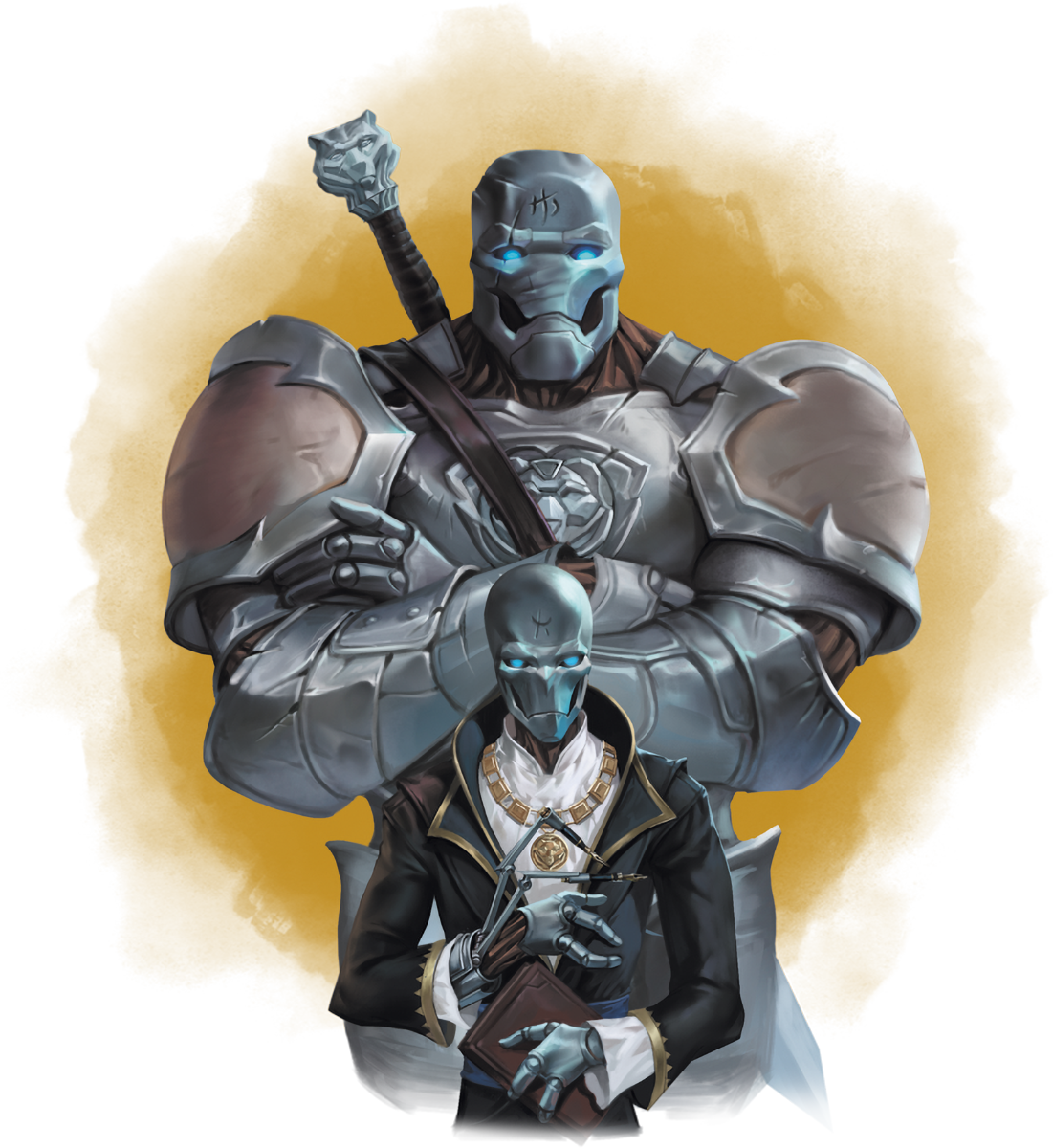 The Magistrate is Count ir’Blis’s personal representative in Quickstone. The current magistrate is a nonbinary warforged envoy named Facet, but they prefer their title to their name. The Magistrate prefers numbers to people, and spends most of their time writing and analyzing reports. While they carry the authority of the count, they rarely exert this power unless called on to do so by the Town Council; primarily they concern themselves with the proper allocation of royal funds and ensuring that taxes are collected (and are at least marginally accurate). The Magistrate is supported by a handful of clerks and servants who maintain the town hall. They also hold authority over the King’s Assessors, a minor and unloved branch of the Dark Lanterns that investigates smuggling and assesses taxes. At the moment, the Magistrate only has a single assessor in his service, a Khoravar named Tam Underbridge; Tam’s partner suffered a fatal accident a month ago. The King’s Assessors are sometimes called “Canaries,” as their deaths are often an early sign of trouble…
Sheriff Constable enforces the law. A warforged juggernaut, his utter adherence to military regulations caused his comrades to name him “Constable,” and he chose to embrace that name. So, he’s the sheriff, Constable. He’s disgusted by the greed and pettiness he sees in the common citizenry, but he knows that he lacks the resources to pursue every criminal and has adapted to the realities of his position. Nonetheless, anyone foolish enough to break the laws of Breland in his presence should expect swift justice; he may overlook deals made in the shadows, but he will not let a crime he observes go unpunished. He is very protective of the Magistrate, who at the moment is his only real friend.
The sheriff has four deputies, who are generally kept busy just maintaining the town hall and watching the streets. Constable has the authority to deputize anyone as needed in the pursuit of his duties. This could result in him turning to the player characters if they earn his trust; otherwise, he’ll generally turn to the Grizzlies, as these veterans are mostly loyal to ir’Blis.
The Town Council is an elected council that currently has six members, each representing one of the factions in Quickstone. According to the town charter, councilors serve three-year terms, with two councilors coming up for election each year (on 9 Rhaan, Boldrei’s Feast); in practice, there’s only been two elections since the system was put into place. The primary role of the council is to make requests of the sheriff and the Magistrate. They can request the use of royal funds, demand that the sheriff investigate a particular crime, or address other civic concerns. The current councilors are Astan Morn (The Mourners), Gareth Stone (the Chanters), Jessa Grain (The Grizzlies), Rhia d’Orien (House Orien), Vesper (the Church), and Zel Tuuva (Tuuva Mercantile). While it’s quite unusual for a dragonmarked heir to hold such a position, the people of Main Street support Rhia and the Magistrate allowed it. All that it takes to be a councilor is the support of a significant number of people and the desire to do the job. This is certainly a position an adventurer could hold, and if you think your character might already be a member of the town council at the start of a campaign, discuss it with your DM, and they might have you replace one of the current councilors.
There’s always a host of rumors floating around about the Town Council. It’s up to the DM to decide which of these are currently circulating, and which councilors they apply to.
| d6 | Rumor |
|---|---|
| 1 | One of the councilors is possessed by a fiend or a vengeful ghost. |
| 2 | Two of the councilors are engaged in a vicious vendetta, though no one knows why. |
| 3 | One of the councilors has been making secretive trips into the Haunt. |
| 4 | One of the councilors has been carrying out direct negotiations with a Droaamite warlord. |
| 5 | One of the councilors is working with the Swords of Liberty or the Black Crown Company. |
| 6 | One of the counselors has started a cult; this could be a Cazhaak cult of the Dark Six, or something stranger. |
So what’s considered a crime in Quickstone, and what are the consequences of bad behavior? In general, Quickstone adheres to the Code of Galifar. Theft, assault, fraud, and murder are all crimes, and they are crimes, whether carried out with weapons or magic; in the eyes of the law, there’s no difference between using Suggestion to trick someone into giving you their valuables and using the threat of violence to accomplish the same thing. However, as called out above, the primary question is whether anyone is going to actually report the crime, and if they do, whether the sheriff will take up the case. In the case of the person who’s been charmed out of their goods, are they going to report it, or will they be too embarrassed to do so? Was the victim someone who’s important to the town, or were they an annoying merchant passing through, who most people feel got what was coming to them? Sheriff Constable has limited resources and his primary concern is maintaining order. If a bad hand of Thrones results in a brawl in which no one is seriously hurt, no one is going to bring down the law. Most anything that happens in the Tents is going to be ignored. On the other hand, if someone were to brazenly rob Kemble Bank or steal from Bel at the Anvil, they shouldn’t expect to just remain in Quickstone without consequences.
If you commit a crime in Quickstone, the first concern is witnesses. Are there people who see what’s going on? If so, do they care? Again, when there’s a random bar brawl, many people are more likely to join in than to call for the law. But if someone spots you using Suggestion to cheat Bel, do they realize what’s going on? Do they want to help Bel? Most people in Quickstone won’t actually directly intervene, but they’ll raise the “hue and cry”—calling out for help and describing the crime. The goal is to call a crowd and bring in witnesses. Hopefully, this is enough to cause you to rethink your actions; if not, even if the crowd doesn’t want to engage you, they may try to block your escape until someone arrives who will take action. That should be Sheriff Constable or his deputies, who will usually first call on you to surrender and then try to bring you down by force; they’ll try to take you alive, but if you resist arrest, they won’t try too hard. If Constable isn’t around, it’s possible that a vigilante will step up to intervene. Grim, the bouncer at the Crown, has brought down criminals before when called out by the hue and cry; the veterans known as the Grizzlies might also step in when the law is unavailable.
There are two cells in the Town Hall, but these are mainly used for unruly drunks or to hold people until judgment; long-term incarceration isn’t an option. In a clear-cut case, Sheriff Constable can simply impose a penalty immediately; if things are more complicated, the criminals will be brought before the Magistrate, who will call for testimony within a Zone of Truth (which they can cast) and render a judgment on behalf of Count ir’Blis. The simplest punishment is humiliation: offenders may be placed in stocks in the Square for a period of time, forced to make a public confession and apology, or carry out some form of public service. Fines are the next most common punishment, sometimes defaulting to indentured servitude if the offender can’t pay. For serious crimes or repeated offenses, execution is always on the table. Another option is to be (literally) branded an outlaw; as an outlaw you are no longer a Brelish citizen (if you ever were) and not entitled to the protections of the Code of Galifar. It’s worth noting that a crime is only a crime if it’s committed against someone protected by the law, which outlaws and the denizens of Droaam are not! Robbing a visiting medusa may not be the smartest thing you could do, and could make you powerful enemies if it interferes with, say, her delicate negotiations with House Orien; but it’s technically not a crime under the laws of Breland.
With all that in mind, vigilante justice is alive and well on the Western Frontier. Even if Sheriff Constable and the Magistrate aren’t involved or choose not to pursue a crime, other power groups in town may take action on their own. The criminal elements within the Coins have a strict code—notably, not targeting residents with crimes—and may take direct action against lone wolves or even other Coins who break these rules. The veteran militia known as the Grizzlies may also take the law into their own hands—especially if Mourners or natives of Droaam are causing trouble.
Dueling is a sound example of something that is illegal under Brelish law, but that’s an established tradition on the frontier. If you walk into the Crown and shoot someone in the back, people are going to report it to the sheriff. But if you boldly call out your enemy, proclaiming your justified grievances for all to hear—and assuming your grievances are justified—it’s likely the crowd will support you and call for a duel. Dueling is illegal, and if Sheriff Constable is present when you issue a challenge, he will be obligated to intervene. But there’s been at least one instance when the sheriff was seen walking toward a duel in progress and then suddenly stopped to study a fascinating stone he’d stepped on, keeping his head down just long enough to miss an incident. Of course, this is a double-ended wand: if you have justification, you can call someone out for a duel… but likewise, if you wrong someone, they can call YOU out. Anyone who refuses a duel that the crowd considers justified will draw a lot of hostility and may be refused service, be insulted, or worse; if you’re just going to ignore a challenge, you might want to leave town for a while.
The inhabitants of Quickstone are citizens of Breland, and most are Vassals of the Sovereign Host. The holy days of the Sovereigns are celebrated in town, as are a number of local festivals. The holy days of the Silver Flame are not largely acknowledged. The Day of Mourning is an important day for the Mourners, but last year there wasn’t a town-wide recognition of it.
The Aram’ja is a tradition of the Cazhaak faith, observed by the kobold community in the Tents. Literally translated as bright rage, easterners often misinterpret it as “frenzy,” but those who know the Cazhaak traditions prefer the term “revel.” The Aram’ja is a celebration of the Fury in which participants seek to experience primal joy, to live for a night unfettered by reason and the expectations of others. While for some, joy alone is a satisfactory goal, the ultimate purpose of the Aram’ja is to briefly break free from rational thought and, through that experience, find the true self that lies beneath. Most Vassals want nothing to do with the Aram’ja, but a few townsfolk have taken part in it; some found it to be terrifying, while others describe it as liberating.
The Aram’ja is a chaotic whirl of dance and song. It takes place on the 18th night of each month. An especially grand revel—the Ghaalaram’ja—is held on the 18th night of Sypheros, which the townsfolk identify as Wildnight.
The Last War is over, and the lightning rail has come to Quickstone. There’s a new Gold Dragon Inn and soon there will be a major Kundarak enclave. Quickstone is on the verge of prosperity… but what will it take to get it to the next step? What can draw people to come to Quickstone itself, not just to stop there on the way to Graywall? Vesper, the local priest of the Sovereign Host, has been working on this, and her initial idea is sand fruit. It’s something exotic that people don’t have in the east. The only problem is that when it comes down to it, sand fruit is terrible. It’s remarkable for its ability to thrive in the harsh environment, but even in Quickstone most people would rather have an orange or an apple instead of sand fruit. Vesper is determined to overcome this handicap, and is encouraging the townsfolk to come up with exciting ways to celebrate sand fruit.
The Sand Fruit Festival is a holiday that hasn’t actually happened yet, and it’s up to the DM to decide when and if it will happen. Vesper is forever working on new ways to make the Sand Fruit Festival a reality. She may try to combine it with a music festival (songs celebrating sand fruit!) or some other celebration, such as Bounty’s Blessing. Whatever happens, Vesper will always encourage people to pursue any path that could interest people in sand fruit and the festival. Keep in mind that part of Vesper’s interest in this is profit. She doesn’t just want a party; she wants this to be something that brings gold to Quickstone.
Many of these are discussed in more detail in Eberron: Rising from the Last War. While each of these events are tied to the celebration of one of the Sovereigns, they have largely become secular events and most everyone in the town participates. While most of these are celebrated across the Five Nations, a few—Turrant’s Reckoning, Shargon’s Bargain—are less common, as they’re holidays inspired by the Three Faces sects or Cazhaak traditions.
Onatar’s Flame (7 Zarantyr). In the wake of Long Shadows, the feast of Onatar celebrates the hard work of keeping the fires lit and the forges running even in the heart of winter. A great bonfire is lit in the Square. A week before the festival, the priest Vesper sets a theme, and all the artisans in town produce something tied to that theme; these works are presented around the bonfire and judged. For the last two years, the blacksmith Bel has served as a judge and allowed amateur smiths to use the Anvil’s facilities in the week leading up to Onatar’s Flame.
Turrant’s Gift (14 Olarune). The feast of the Keeper is a festival of the Three Faces of Coin. To an outsider, it has the appearance of an open market in the Square, with an unusual assortment of goods; the principle is that it is a day on which anything can be bought, and no questions are asked about where the goods come from. So far, the Magistrate has indulged this tradition, but it is essentially a celebration of the black market and things could change. Pennyroyal smugglers consider the week before the festival to be blessed, and will often time audacious schemes to fall in this period.
Winter’s End (28 Olarune). The feast of Olladra is a celebration of good fortune and of surviving winter. While not as raucous as Wildnight or as extravagant as Boldrei’s Feast and Bounty’s Blessing, it is a time for celebration. Musicians and entertainers perform in the square, and there are games of chance with lighthearted prizes.
Sun’s Blessing (15 Therendor). Dol Arrah’s day is a celebration of peace. The priest Vesper gives a sermon in the Square, and people are encouraged to forgive their enemies, celebrate their common ties, and find a way to settle any lingering grievances or feuds.
Shargon’s Bargain (13 Eyre). There’s no public feast on this day, and it’s a holiday many don’t acknowledge or even know about. For those who do, this is a day to make a sacrifice to the Devourer, placating him so disaster will pass over the farm in the year ahead. Traditionally, this involves the burning of some part of a field—typically, land the farmer planned to leave fallow, allowing the soil to recover. So there’s no celebration, but if you travel at this time you may notice a number of burning fields.
Aureon’s Crown (26 Dravago). This is a celebration of knowledge. In previous years, school teacher Tragomir Narathun and stonespeaker Sahra Syrralan d’Sivis have both given lectures in the Square, discussing history and other topics of general interest; any visiting sages will be encouraged to participate. While there is no public feast, families are encouraged to hold gatherings with friends, at which the elders will share their wisdom with the young.
Second Skin (11 Nymm). An old tradition that’s been abandoned in much of the Five Nations, Second Skin is the Mockery’s day—preceding Brightblade, reflecting Dol Dorn putting an end to the Mockery’s treachery. Second Skin is a day to try to frighten your friends; the name comes from it being traditional to wear costumes, concealing your identity while playing tricks on your loved ones. While in the past it was considered a blessed day for actual treachery, in Quickstone these hijinks are typically well-intentioned and harmless.
Brightblade (12 Nymm). The feast of Dol Dorn involves a day of martial contests in the Square: archery contests and wandslinging displays, prizefights, tests of strength, and more. The Grizzlies are the driving force behind the Brightblade festivities; there has been a growing drive to have contests between the Brelish veterans and former Cyran soldiers. Most of the Mourners have pushed against this, but some find it appealing; if this goes forward it could be a source of tension.
Bounty’s Blessing (14 Lharvion). The festival of Arawai is a celebration of the summer harvests. There is a grand farmer’s market in the Square, along with cooking competitions and a formal giving of thanks. Given that farming is difficult around Quickstone, this festival isn’t as dramatic as it is in some other parts of Breland. As mentioned earlier in this chapter, the priest Vesper is pushing for 998 YK’s festival to focus on the local sand fruit.
The Hunt (4 Barrakas). Rather than bringing in an exotic beast, during Balinor’s festival, local hunters compete to bring in the most impressive prey. Hunters display their trophies in the Square; traditionally the meat and hides are donated to the community, serving as the foundation of the evening feast at which hunters tell tales of their deeds.
Boldrei’s Feast (9 Rhaan). Another grand feast in the Square. Where Winter’s End is a celebration and Bounty’s Blessing focuses on farm and food, Boldrei’s Feast is a time for the community to come together and strengthen ties—for people to find a way to help their neighbors, and to get to know them better. House Ghallanda traditionally supports the celebrations, and Lady Hazel of the Gold Dragon Inn plans to do her best. Meanwhile, Honoria Soldorak holds a grand ball at Soldorak Manor on Boldrei’s Feast for people she considers to be community leaders or people of quality.
Wildnight (18-19 Sypheros). There is always a raucous party in the square on Wildnight, but the real celebration takes place in the Khaar’paal camp in the tents, where the kobolds celebrate the event they call Ghaalaram’ja.
Market Day (20 Aryth). The feast of Kol Korran is especially important to the Coins, and receives more attention than in most cities. There is a grand flea market in the Square. As opposed to Turrant’s Gift, which celebrates the black market, Market Day is a chance for everyone to make a deal. It’s a time when people dig deep and find treasures they no longer need, bringing something to the market. Traditionally, people don’t spend gold on Market Day; everything is purchased by barter, whether trading in goods or favors. Families and friends often hold smaller gift exchanges at the end of the day—while in theory this is about equal exchange, it’s common for parents to trade much-wanted gifts to their children in exchange for whatever the children make on their own.
Long Shadows (26-28 Vult). This is an especially dangerous time in Quickstone. Setting aside the traditional fears of dark powers stirring on these nights, the warriors of Turakbar’s Fist and other Droaamite raiders tend to be especially active in this period, and there has almost always been some sort of attack in this time. Everyone stands ready to defend those that they love; the streets are generally empty, and children are especially forbidden from approaching the Haunt. While people generally huddle in their houses on the nights of Long Shadows, Honoria Soldorak has discussed holding a grand gala at Soldorak manor this year—combating the darkness with a joyous celebration.
Quickstone is built on quickstone, both figuratively and literally. The quickstone deposits were what drew people to establish the town in the first place, both before and after the rise of Droaam. The first citizens of the town were miners and stone chanters. The Stone Games are a celebration of that history. The games involve a series of tests of strength and endurance tied to quickstone and the mines. Hammer tossing, tug of war, and both lifting and bearing quickstone weights are all part of the games. Stone chanters display their skills with impromptu quickstone sculptures. Over the last two years, the games have evolved to include county fair elements. Noon Tuuva bakes sweet treats, Flourish and Rose of the Rose Theater organize entertainment, and everyone looks for ways to add to the joy. With that said, the miners themselves aren’t entirely happy with this evolution—or with the fact that Blues and Mourners have started competing in the games and winning some of them. This could be an ongoing source of tension in future Stone Games.
The Stone Games don’t occur on a set day. They generally occur every six months, but Cord Risten—barkeep of Stone Soup—sets the exact date, saying that “It’s all a question of listening to the stone.”
There’s only one church in Quickstone, and it’s devoted to the Sovereign Host. But that doesn’t mean it’s the only faith in town.
Most of the people in Quickstone are at least casual Vassals: they believe in the Sovereigns enough to swear by them. The most faithful Vassals in town are in Oldtown, also largely devotees of the Three Faces of Coin. This mystery cult’s followers normally hide their faith, but because they make up a significant portion of the population, the Coins are more open about their faith. Their beliefs are discussed in more detail in chapter 2; in short, they revere Onatar, Kol Korran, and Kol Turrant—the Keeper—above all other Sovereigns. While it’s no secret that the priest Vesper is a devotee of the Three Faces of Coin, she still performs services for all the Sovereigns. She preaches twice each week, with one sermon for the Host and one for the Coins; Pennyroyals politely but firmly exclude non-believers from the Coins sermons. Vesper also presides over the religious festivals on all the Sovereign’s holy days.
There are a handful of Droaamite immigrants in Quickstone who worship the Cazhaak interpretation of the Dark Six, and a few of the locals have picked up their traditions. The most significant worshipers of the Six are the Khaar’paal kobolds. Their priest, Sarvus’kor, is devoted first and foremost to the Fury, and presides over the monthly Aram’ja revels; however, she knows the ways of all the Six and can offer guidance to any who follow the Cazhaak traditions. The Khaar’paal create small shrines to the Six in the wilds around Quickstone, though these are intentionally impermanent.
The druid Briar often comes to town to sing and tell stories, whether in the common room of the Crown or in the Square. They rarely stay in Quickstone, preferring to sleep under the open sky. While Briar isn’t trying to get Vassals to abandon their faith, through their stories and songs they are trying to teach the lessons of the Greensingers, to help people understand the role of the fey and to know how to coexist with them.
Quickstone was founded by Vassals, and there’s no significant following for the faith of the Silver Flame in the town proper. There are a handful of followers of the Flame among the Mourner refugees, and Elin Ton maintains a small shrine in the Vermishard camp in the Tents. The priest Epitaph passes through regularly; she rarely tries to convert people to her faith, but she offers guidance to the Mourners and seeks to inspire by her example.
There aren’t many other faiths with a significant representation in Quickstone—though it’s always possible that there are one or more cults that are hidden from the public eye. If you’re playing an Acolyte or priest of a faith other than the Host, you could try to spread your faith and establish a shrine or temple!