
Play Now
Join a Game
Characters
Shop
Tools
Compendium
Community

Sign In

Play Now
Join a Game
Characters
Shop
Tools
Compendium
Community
Sign In
Magic items are just as important to everyday life on the frontier as they are in the Five Nations. Some of the items presented in this section can be found across the Five Nations; it’s simply that, because the frontier has more than its fair share of wandslingers, this may be the first place you encounter a Duelist’s Scorecard or a Flashdraw Wand. Other items are unique to the region—and in some cases, entirely one of a kind!
A few of the items that follow allow for casting spells found in Xanathar’s Guide to Everything. These spells are reprinted in chapter 4.
Rarity and Unique Items
The rarity of a magic item—from Common to Legendary—serves multiple purposes. It suggests the relative power of an item; an Uncommon magic item is assumed to be weaker than a Rare one. It’s also a factor in calculating the cost of creating or purchasing a magic item. However, sometimes using one word for all of these purposes runs into problems. If an item is both exceptionally rare and also extremely weak, should it be rated Common based on its power or Legendary based on its actual rarity?
With this in mind, there are a few items presented in this chapter that are called out as being Unique. The Misthaven Miscellany isn’t very powerful, and thus it is rated as Common, but it’s a unique treasure from Thelanis. Jury d’Cannith created the only existing Jury’s Squeaky Wheel; someone could replicate it, but you won’t find it in a shop. Other items in this section aren’t unique, but simply can’t be purchased; House Orien doesn’t sell its Thunder Coaches or Lightning Runners. So, the rarity of the items in this section indicates their relative power, but it’s up to the DM to determine if these items can be found in a campaign.
 The items in this section are treasures that can be found in the villages and wilds around the Border Road, from the town of Quickstone up to Sylbaran. Some of these are creations of local artisans; others are items that are especially popular with the wandslingers and brigands found in this region.
 Most scholars of the Age of Demons are familiar with the story of Rak Tulkhesh—how the prison of the Rage of War was shattered, and how even a tiny sliver of the overlord’s essence can have a dangerous effect on anyone who comes into contact with it. What’s sometimes misunderstood, however, is the concept of the prison itself. It’s often thought that the overlords are bound within Khyber dragonshards, but that’s not actually the case; the overlords are in fact bound by the Silver Flame. To trap these immortal spirits, the Flame caught the essence of the fiends and, essentially, crystalized it—creating a sort of violet obsidian not unlike a Khyber shard, a substance that is virtually indestructible but infused with fiendish power: demonglass. The prisons of the overlords themselves (containing a fraction of the overlord that is extended beyond the borders of its heart demiplane, as discussed in Exploring Eberron) are massive demonglass shards. But many lesser fiends were also caught by the Silver Flame, and they too were bound into a crystalline form.
There are two key types of demonglass in the world. Raw demonglass was used by the overlords themselves as a sort of building material. It is pure, solidified evil—an unnatural and almost indestructible substance that registers as a fiend when someone uses Detect Evil and Good or a paladin’s Divine Sense. But raw demonglass has no focused sentience, and it can be found in massive quantities. There are reefs formed of raw demonglass in the Thunder Sea and ridges of demonglass in the Demon Wastes. The fortress of Turakbar’s Fist is formed from raw demonglass. It’s durable and radiates malevolence, but there is no intensity to it. By contrast, bound demonglass contains the essence of a native fiend that once had an independent form. This could be any sort of fiend. While the rakshasa are the most common form of native fiend in the present day, one reason for this is that they were the most resistant to the binding. A chunk of bound demonglass might hold the essence of an imp, a vrock, or even a marilith. These entities are native fiends, most directly tied to one of the overlords. Most cannot affect the world while bound. But their power is held within the crystal, and with the proper rituals it can be drawn out. Mortal champions who serve an overlord might embed demonglass in their own bodies, while arcanists may find ways to channel the power of a fiend into an object. Over tens of thousands of years, the Lords of Dust have crafted many objects that draw on the power of demonglass; they may not be able to free their bound brethren, but they can still use their power.
Most of the items in this section were made by fiends as tools to arm their servants or corrupt their enemies. Those found on the Western Frontier are often tied to the overlord Tol Kharash, who loves to intimidate foes; the appearance of such relics will be brutal and cruel. However, it is possible for any artificer to use bound demonglass as a source of power when creating a magic item. However, if they don’t know what they’re doing, this could result in the item becoming cursed—or even waking the fiend, creating a sentient item driven by a malevolent spirit.
These are just a few examples of fiendish treasures. Any magic item could have a fiendish aspect. A servant of Eldrantulku could craft Daggers of Venom with slivers of demonglass in the hilts. The point is that demonglass is a common thread for these items—and that items made with demonglass will register faintly to any effect that detects Fiends.
Demonglass is virtually indestructible; it takes magic on par with a Wish to shatter it, and even then the splinters will remain. Because of this durability, it is nearly impossible to shape it; items tied to demonglass generally incorporate a shard of it.
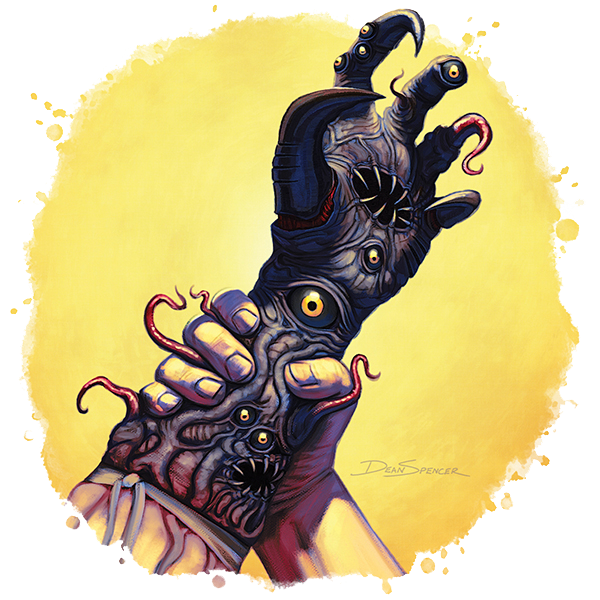
The daelkyr like to create living tools and weapons; objects formed from chitin, bone, and muscle. Many of these items bond to their bearer, drawing sustenance from the creature attuned to them; for this reason, they are commonly called “symbionts.” Though a symbiont is a living tool, it is mechanically considered a magic item, not a creature.
When presenting an existing item as a symbiont, the DM must decide whether to add the Symbiotic Nature feature that other symbionts have. When such an item is attuned, it can’t be removed from the bearer, even if they desire it; the only way to end the Attunement and remove the symbiont is to use an effect that ends a curse. This prevents the item from being taken away, but limits a character’s free will, so it’s up to the story you want to tell. While Symbiotic Nature is a common attribute for symbionts, it’s not a requirement. A slug that functions as an Everybright Lantern wouldn’t require Attunement. Even if the Periapt of Wound Closure is a scarab that digs into the flesh of the bearer, perhaps it could be pried loose, or it might release its grip voluntarily if the bearer ends the Attunement.
Droaam is home to a wide range of mystical traditions and many common magic items can be found in the region. The tailors of Lost make fine Cloaks of Displacement and the duelists of the Venomous Demesne often wear Brooches of Shielding. The items mentioned here are things that are unique to the region and unlikely to be found elsewhere, unless they are carried by a Droaamite.